
Legal operations as a discipline is at an inflection point. Corporate legal teams and law firms all over the world are adopting new technologies—and thinking seriously about how to better operationalize their tech stacks—with an unprecedented sense of commitment and scale. Gone are the days of data stored in filing cabinets andNDAs sent via fax; of matter managed manually and of legal offices cluttered stubbornly with stacks of paper. We’re even, it seems, past the days when “legal tech” referred mostly to e-billing systems and spreadsheets, email and word processors. How legal teams use technology has become a key determinant of how effectively those teams work to enable their businesses and serve their clients.
Though key hurdles remain. It’s been several decades now since the first generations of contract lifecycle management (CLM) systems, e-billing platforms, matter management tools, and eDiscovery software tools were introduced. These solutions helped lawyers and legal teams better track spend, organize documents, and respond more efficiently to litigation. Yet they often exist in silos—each solving a narrow problem—and rarely are they integrated with the broader enterprise stack. And in part because they remain hard to use seamlessly together—and even more so because they’re often hard for non-technical professionals to use at all—they’ve never seemed truly capable of transforming the way legal goes about its core functions of service and enablement meaningfully and for the better.
Legal’s commitment to making better use of legal technology is reflected in the rise within corporate legal departments of legal operations teams. In many ways, legal ops matured coterminously as legal technology grew more sophisticated. Once an afterthought within legal departments, legal operations emerged as a vehicle for ensuring they remained data-driven and strategic, efficient and responsive—often through a smarter and more strategic use of technology. Companies invested in legal ops as a means of helping lawyers move from reactive to proactive, from manual to automated, from siloed to more connected, from chaotic to coordinated.
As legal tech stacks grew in size and complexity, this work grew ever more essential.Leveraging new and more powerful technologies coming online, legal ops leaders started adopting things such as intake platforms, workflow automation platforms, self-service portals, and dashboards to manage requests and track KPIs. Still, fragmentation persisted. Legal ops teams found themselves trying to automate workflows across a patchwork of disconnected systems, composed of tools valuable in isolation, yet difficult to use in conjunction with each other.
Among legal and legal ops teams, manual work—triaging requests, reviewing contracts, coordinating approvals—remained stubbornly prevalent. Visibility across the legal function remained frustratingly limited. Adoption of tools and compliance with internal processes: terribly inconsistent. The potential transformational value of legal technology, and the wisdom of investing in more of it, appeared to have hit a ceiling.
Then came the rise of AI, AI agents, and agentic orchestration. This technology offered legal teams something new entirely: tools that could work alongside legal in the manner of a networked colleague. Large language models can extract clauses from thousand-page contracts in seconds; AI agents can draft NDAs, answer employees’ policy questions, and proactively elevate risks in even less time.Combined with agentic orchestration platforms, which allow legal ops teams to automate workflows powered by agents across teams and technology systems,AI agents can help legal teams deliver services that are faster, more consistent, and better aligned with the business than ever before.
The promise inherent in these new capacities spurred a boom in legal technology production and a corollary explosion in new legal tech investment. Yet with all this new capacity, concerns remain about data security, model accuracy, and governance. Concerns remain about data security, model accuracy, and governance. Some leaders remain unsure about how to train employees, integrate AI into existing processes, or demonstrate ROI. Others question whether AI will truly reduce workloads or simply shift them. And amid broad adoption of—and enthusiastic investment in—new AI-powered legal tools, most process experiences internally remain fractured and relatively inefficient and lack visibility.
Which brings us to today. Within legal and legal ops teams, the tools at our fingertips feel powerful and full of transformative potential in ways they never have. Yet most legal and legal ops teams are still searching for ways to use those tools safely, harmoniously, and in a manner that ensures we one day realize their true potential.
What proven strategies show promise? Should forward-thinking legal and legal ops teams double down on AI experimentation, or focus first on integrating their existing tools? What operational issues still feel intractable? Should orchestration be prioritized as the connective tissue of the tech stack? How can teams build a roadmap that balances innovation with governance? And what outcomes—efficiency, compliance, human experience—should define success?
These were the questions we sought to answer with this survey.
Widespread investment, fragmented use: Nearly every major legal techcategory is in play—contract review (66%), matter management (57%), and CLM (51%)—but few organizations report seamless integration across tools (only 25% say “fully integrated”).
Intake experience is pivotal but inconsistent: While 52% rely on dedicated intake/orchestration platforms, 40% still route work through generic ticketing systems. Stakeholder satisfaction is modest (only 11% “very satisfied”), and satisfaction strongly correlates with intake integration.
AI has momentum, but lack of connection is a bottleneck: 60%+ already use AI to triage intake, review contracts, or draft clauses, and AI agents are widespread, yet data privacy (45%) and implementation complexity (46%) rank as top barriers.
2025 priorities concentrate on orchestration: “Improving intake/orchestration” (50%)—in part for its capacity for improving connection and empowering org-wide use of AI agents—and “enhancing analytics dashboards” (41%) outrank CLM refreshes as top tech improvement goals.
The pages ahead endeavor to capture insights—not provide prescriptions—but they serve, in sum, to paint a pretty clear picture of precisely why this is such an exciting and potentially important moment in the evolution of legal operations and legal technology.
The data captured also doubles as a map demarcating the chokepoints and challenges and most broadly pursued operational outcomes that define legalops today—and that seem to inform the direction it’s headed.
We hope you can use it to chart your own course through the years of AI-powered change and progress and disruption ahead.
A 360-degree snapshot of legal technology and operations

To understand the true state of legal technology today, we partnered with WBR Research to survey 300 senior practitioners in the summer of 2025. Our mixed-mode approach—combining online surveys with phone interviews—captured both quantitative data and qualitative insights from procurement leaders worldwide.

We cast a dutifully wide net. The majority of respondents hailed from mid-to-large enterprises (36% with 1–5K employees, 33% 20K+), and spanned more than 15 industries in regions across the world. This breadth ensures our findings reflect true market conditions, not regional or sector-specific quirks.

The average legal department now manages between eight and 10 separate, legal-specific systems.

Legal ops continues layering innovative point solutions, like E-billing, AI-powered contract review, and intake platforms, atop more entrenched legacy legal systems, such as CLM and matter management platforms.
This has increased capacity but, on the flip side, introduced new complexity—which explains the growing popularity of workflow automation and process orchestration tools.
This reflects a learning we’ll see threaded throughout our survey results. Legal ops has more technological firepower at its fingertips than ever before. But the downside of that is it’s made tech stacks more complex—and processes more convoluted—than ever. (As one respondent told us, “Honestly, we have more tech than we know what to do with.”) Which is why the next focus for legal ops teams is not further accumulation, but connection and orchestration.
Implication:
Legal ops’ chief bottleneck is no longer functionality, but fragmentation. Companies in financial services show higher compliance/risk tooling adoption (+12pp vs avg).
There’s a growing appreciation within legal ops of the importance of intake.

Where and how employees are enabled to submit requests to legal—and the manner in which legal ops teams are efficiently able to triage and appropriately route those requests—affect everything downstream. There seems to be a growing appreciation for that, which is perhaps why 52% of respondents reported having invested in tools for managing intake. Fewer than 5% said they’re still only using portals and forms.None reported relying exclusively on email or other manual means.
So what?
The effectiveness of your mechanisms for managing intake and for orchestrating requests and approvals across the legal department directly informs the efficiency and focus with which your legal team is able to operate. Ineffective intake and orchestration results in low process adoption and more manual work. Effective intake achieves the opposite; that’s perhaps one reason why stakeholder satisfaction is 2.5x higher among respondents who’d invested in orchestration platforms for managing intake vs. ticketing-only systems.
Legal is delivering—but not delighting.
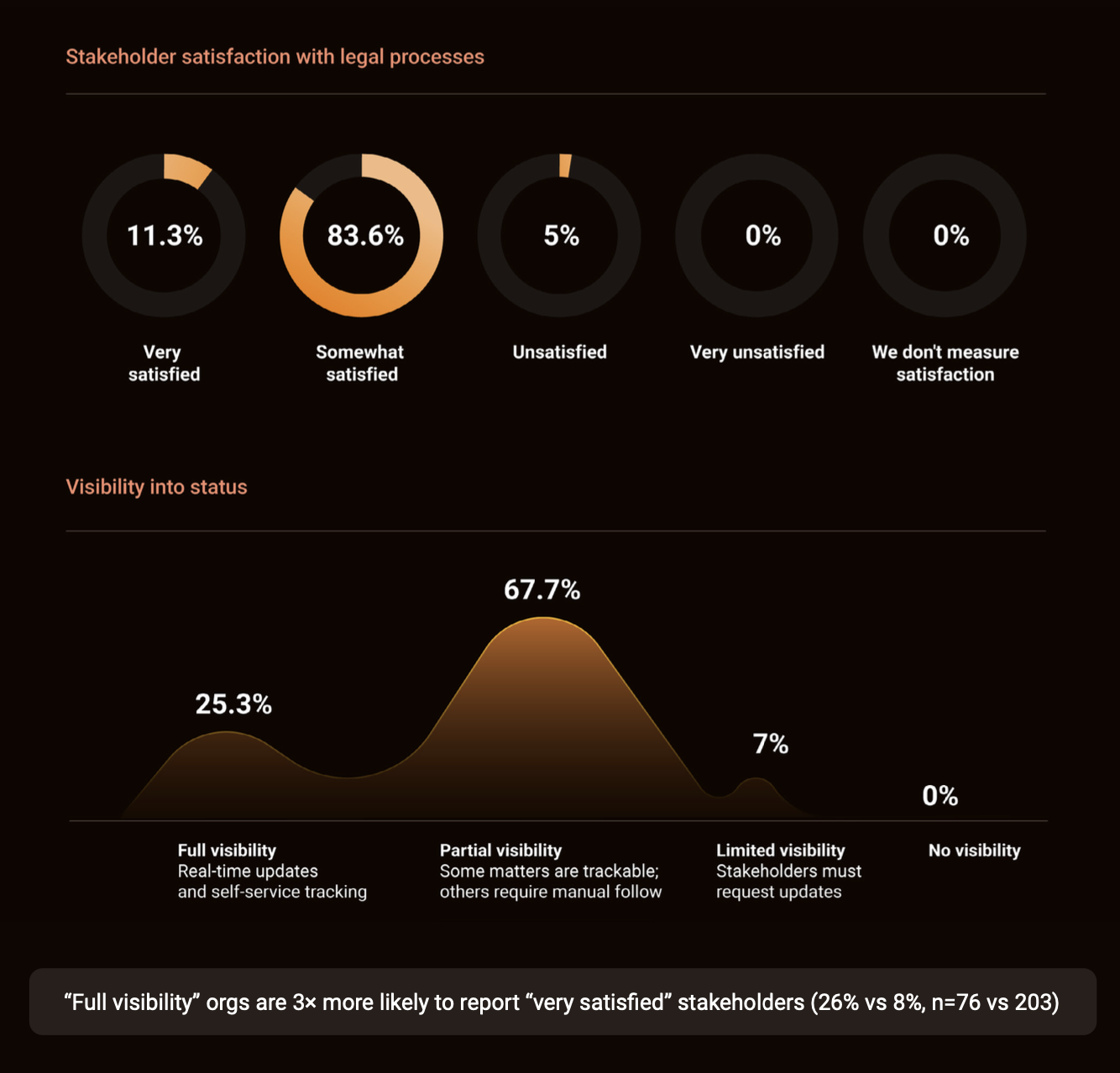
Complex tech stacks that aren’t integrated lead to complex process experiences. Such processes not only quell stakeholder satisfaction—only 11% of respondents reported their stakeholders feeling “very satisfied” with legal process experiences—but inhibit visibility. (Only 25% of respondents report providing stakeholders real-time transparency into things such as the status of their legal request.)
“Full visibility” orgs are 3× more likely to report “very satisfied” stakeholders (26% vs 8%, n=76 vs 203)
So what? Unsurprisingly, when processes guarantee visibility, stakeholder satisfaction goes up.
Even with tech, legal cycles lag.


Legal ops often complete intake, triage and coordination relatively speedily—that’s something that came through clear in the data. (This could be a product of increased use of intake platforms.)
But, generally, legal cycles remain longer than respondents would like. This appears to be a product of how often legal processes run into bottlenecks. Around 64%
of respondents reported their processes occasionally or often get delayed by bottlenecks.
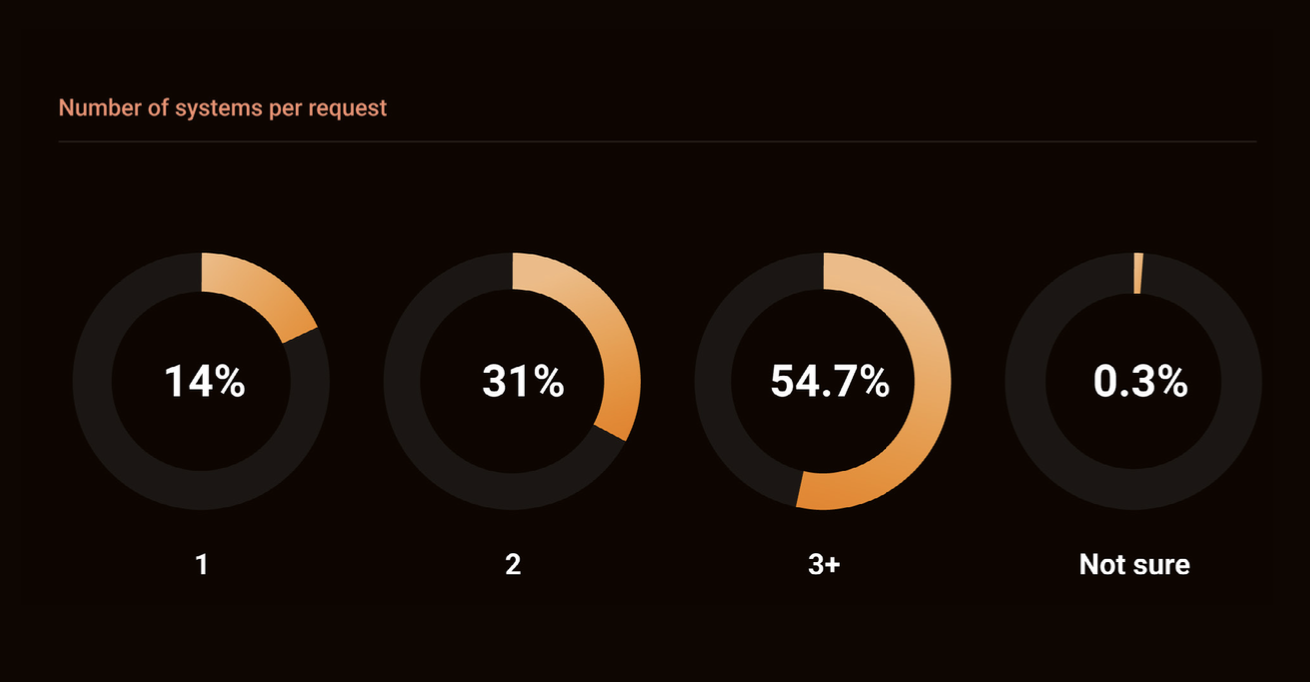
Where do bottlenecks stem from? One source we’re seeing: processes strung across multiple systems that’ve not been integrated well with each other. A whopping 54%of respondents reported that stakeholders have to individually log into more than three separate systems in order to complete legal processes compliantly.
Difficulty coordinating approvals, inadequate analytics, and a lack of visibility are the top frustrations.

It’s not only stakeholders who are frustrated by complex legal tech stacks and cumbersome processes—it’s legal, too.
That’s something we see clearly in the data, which shows that among legal and legal ops team members, the biggest frustrations with the current state of their own processes stem from difficulty facilitating collaboration across teams and tools, as well as a lack of transparency into matter status and analytics.
Non-integrated stacks over-index on “manual workflows” by +22pp.
Connectivity is the missing layer

It would appear one reason frustrations related to process experience, cross-departmentalcollaboration, and a lack of visibility remain so prevalent within legal ops is the tools that are used to facilitate legal processes remain siloed. Only 25% of respondents report their legaltech stack is fully integrated.
So what?
A lack of integration is what forces employees and stakeholders to log into multiple systems in order to complete requests. It’s what creates bottlenecks. It’s what makes facilitating collaboration difficult. And it’s what mandates things like manual data transfer and inhibits visibility. On the flip side, when organizations find ways to stitch their tools together through integration and connectivity, bottlenecks disappear, and satisfaction goes up.
Fully integrated orgs are 2× more likely to avoid bottlenecks (36% “rarely” vs 18% for “not very integrated”).
Dashboards dominate, but siloed reporting persists.

Legal ops teams possess means of measuring performance and use them reliably. 46%use centralized dashboards; 46% rely on built-in tool reporting; only 8% rely on spreadsheets.
Legal is measuring risk, cost, and adoption.

So just what KPIs are legal and legal ops teams measuring? Percentage of matters managed without outside counsel tops the list, followed by cycle time, outside counsel spend percentage, and stakeholder satisfaction.
So what?
Partly this reflects priorities. But some of it is also an extension of precisely what data teams have access to. We found that organizations using centralized dashboards, which can aggregate data from multiple tools, are more likely, among other things, to also reliably track compliance KPIs. (68% vs 44%.)
Experimentation has shifted into mainstream use; amazingly, when it comes to AI adoption, legal ops is pot-committed.

This ranks among the most surprising findings of our survey: a majority of legal teams have already adopted and are in fact already operationalizing AI. Our survey found that 60% of respondents were already using AI agents. Only 9% reported no AI use.
It’s perhaps partly a reflection of how troublesome are the problems related to efficiency and visibility and process experience that legal ops teams have embraced AI so enthusiastically—far more enthusiastically, to be sure, than one might have imagined just a few years ago; historically, legal has proven slow to experiment with new technology.
But dive deeper into the data and something else becomes clear: legal and legal ops teams are not only experimenting with AI, but finding exactly what applications of it are most transformative for the legal function—and on these applications they’re focusing their implementation efforts.
There have been ample reports in the media recently highlighting just how many AI implementations inside the enterprise have failed to produce any ROI for organizations.
The exception in many of these studies, however, have been implementations focused on back-office work, such as that completed by functions like legal. In a way that would have seemed shocking years ago, legal and legal ops are leading the charge when it comes to AI adoption.
Of course, in legal, compliance and safety are sacrosanct. Unsurprisingly, the AI tools favored by legal and legal ops teams are those that serve to improve efficiency and process experience but within specific guardrails and very focused means of governance—for example, highly specialized AI agents, agents empowered to answer policy FAQs, and AI that automates the triage of select intake channels.

Of note: Larger enterprises are leading the charge when it comes to AI agents.Larger enterprises (20K+ employees) 15 percentage points more likely to use autonomous AI agents.
So what? It bears repeating. These aren’t functionalities that respondents areonly planning on investing in, but that many are leveraging right now.
Data privacy, accuracy, and complexity block some adoption.

For as much promise as AI appears to possess for legal and legal ops teams, however—and for all the surprising enthusiasm with which legal has innovatedwith the technology—there remain barriers.
Specifically, 45% of respondents cited concerns related to privacy and security
as impediments to further investment. Thirty-eight percent cited ethical concerns.Conversely, 46% of respondents cited implementation complexity—born, perhaps,of poorly integrated tech stacks—as the primary barrier.
Integration-first, governance-bound.

It would appear that one key learning of the AI implementations undertaken within legal and legal ops so far is that without the proper piping in place—if your teams and tools are not connected—it’s not only challenging to get started using AI, but there endure real limitations regarding what your AI can accomplish. Put simply, if your tech stack isn’t integrated, the long-standing problems related to experience, visibility, and efficiency will remain. That could be one reason respondents cited more seamless system integration as their most desired AI capabilities (61%).
Autonomous task completion (48%) and multi-agent collaboration (43%)came in second and third.
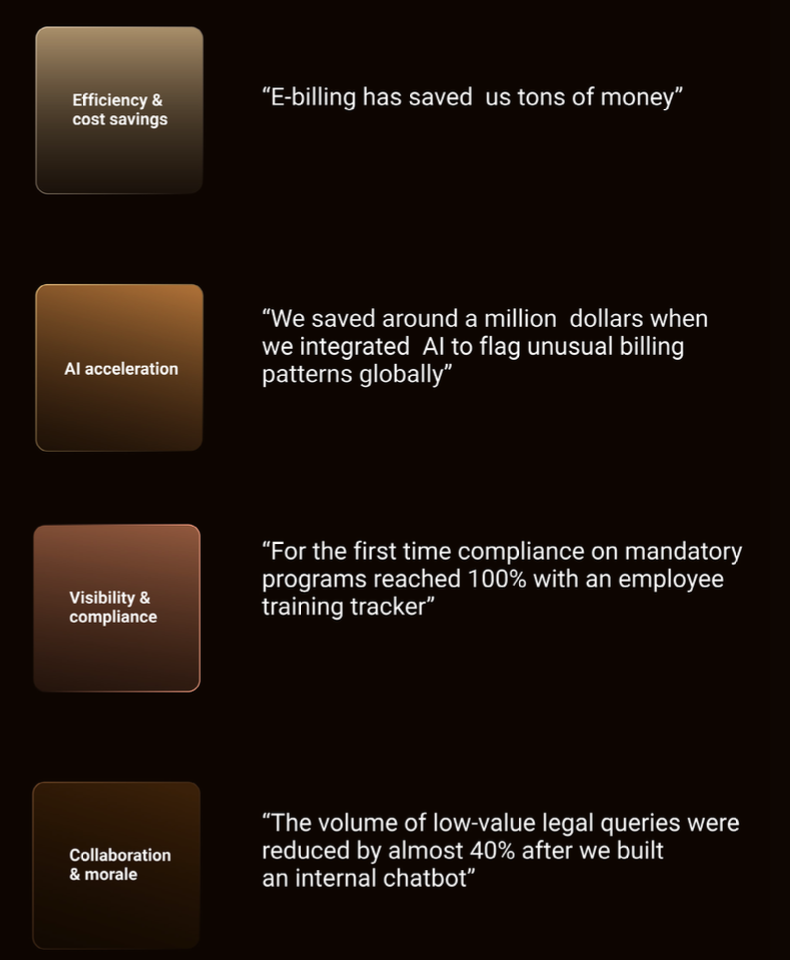
Leaders describe the impact recent tech investments have already had internally
Automation and orchestration top the agenda.

Beyond AI, what aspects of their operations are legal and legal ops teamsprioritizing heading into 2026?
Most are investing in automation and orchestration.
Analytics, AI, and orchestration rise above CLM.

Owing perhaps to their promise for connection, integration, and efficiency gains,most legal and legal ops teams are prioritizing intake and orchestration.
What leaders say they need next.

Legal ops is moving into its orchestration era
The data confirms it: legal operations has come a long way. Yet even after decades of digital transformation, the function’s core challenges remain:fragmented systems, frustrating process experiences, and tools that too often create friction instead of eliminating it.
But so, too, have modern legal and legal ops teams—compelled in part by the promise of AI—demonstrated a remarkable enthusiasm for innovating solutions for these intractable problems. This is evidenced by the popularity of intake platforms and AI agents, among other things.
Much progress has been made. But more work remains. That work comes down not to accumulating more tools, but finding ways to better connect the tools we have.
So it is that legal operations is crossing into its orchestration era. The data shows technological and even process adoption are no longer the core bottlenecks for legal ops teams— rather, silos, poor experience, and inadequate integrations are.
The solution here is connection and coherence. The legal and legal ops teams that win the future—that succeed in realizing AI’s promise to revolutionize the way we work for the better—will be those who succeed in stitching together their tools and teams with integration, who’re able to embed tightly-governedAI agents into their operational infrastructure and orchestrate them across it, and who design end-to-end AI-powered process experiences that both improve the working lives of stakeholders as well as improve the ability of legal and legal ops teams to achieve their core goal of enablement.
We’re not there yet. But it appears a good many legal and legal ops teams are well on their way.