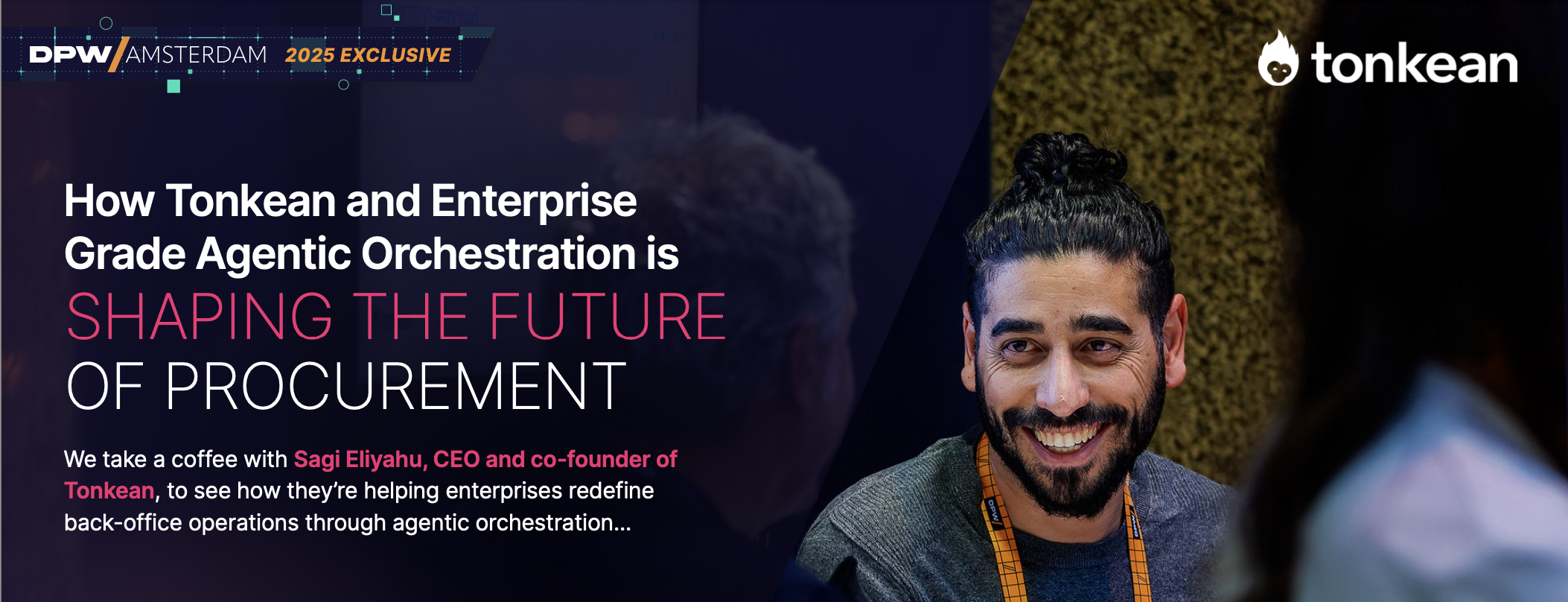
At this year's DPW Amsterdam conference, Tonkean CEO and co-founder Sagi Eliyahu sat down for a magazine interview with CPOStrategy. Below is the interview. The original version of this magazine article with Sagi Eliyahu appeared in CPOStrategy. Read it here.
When Tonkean was founded a decade ago, the term orchestration was hardly part of the enterprise lexicon. Automation was the word of the day, and the focus was on data. But for Sagi Eliyahu, CEO and co-founder of Tonkean, something fundamental was missing from the enterprise software landscape.
“I had this aha moment that business processes are about people, not about data,” he reveals. “But 100% of enterprise software is about data. And while processes almost always span teams and functions, enter- prise software remains siloed. Something was missing - not another tool or feature, but an entire layer. A layer that connects people, systems and workflows seamlessly. That’s what orchestration is.”
From that insight came Tonkean: an orchestration platform designed to help large enterprises bridge the gap between systems, functions and the humans who drive every process. Ten years on, orchestration is no longer a mysterious concept. It’s fast becoming the connective tissue that allows organisations to unify their operations, improve compliance, and leverage AI more effectively. At DPW Amsterdam, you couldn’t escape conversations about orchestration, which were taking place all around us.
Founded in 2015 by Sagi Eliyahu and Offir Talmor, Tonkean is an enterprise-grade orchestration platform that enables large organisations to streamline complex busi- ness processes across teams and systems. Its no-code builder allows back office enterprise teams like procurement, legal and finance to build their own automated workflows and intelligent, personalised user experiences.
Tonkean is also a powerful agentic orchestration platform, meaning enterprises can use it to build, deploy, and orchestrate AI agents across their organization.
Tonkean is used by all manner of enterprise back-office teams— from finance and legal to HR and FP&A—but it’s proven of particular salient use for procurement teams.
“When we started Tonkean, we focused broadly on operations,” Eliyahu reveals. “But over time we built deep, packaged solutions for specific functions. Procurement really took off in the last five years, especially after 2020. That period refocused businesses on efficiency, agility and leverage - exactly what technology should enable. Orchestration suddenly became essential.”
For large enterprises managing complex supplier ecosystems, the pain points are well known. Processes are scattered across platforms and teams. Data sits in silos. Workflows are inconsistent. Despite heavy investment in procurement suites, adoption is often low. Employees often find their own work-arounds; for example, requests still arrive by email, exceptions mount and value leaks through inefficiency.
“That’s where orchestration comes in strong,” says Eliyahu. “It’s not about replacing your systems. It’s about aligning them. You might have a CLM, a sourcing platform, and multiple supplier management tools. But if 90% of your requests still come through email, you have an orchestration problem. You’ve built the machinery, but you’re missing the assembly line.”
With Tonkean, organisations can build that assembly line. The platform acts as an intelligent layer sitting on top of existing tools. With it, you can orchestrate processes across systems and stakeholders end-to-end. The results are tangible and transformative.
“Customers have seen onboarding times drop from months to days,” Eliyahu notes. “But beyond efficiency, it’s about quality. When you orchestrate a process properly, you ensure consistency and accuracy in every step. That’s what turns automation into real business value.”
Procurement leaders increasingly recognise that user experience drives compliance. If a process feels cumbersome or unintuitive, employees will go around it. Orchestration allows organisations to design experiences that fit the user - not the other way around.
“In many cases, the best experience is no experience,” says Eliyahu. “People don’t necessarily want to open another portal just to confirm an order or request a contract. Maybe sending an email is perfectly fine. The problem is that the procurement team can’t handle all those unstructured inputs efficiently. That’s where orchestration and, increasingly, AI agents, can make the difference.”
Tonkean’s platform can meet users wher- ever they work - in email, Slack, Microsoft Teams or other tools - while ensuring the back-end processes remain structured and compliant. It’s a personalised approach that adapts to different departments, systems and maturity levels, making adoption more natural across the enterprise.
“True orchestration manages the process end-to-end,” Eliyahu explains. “That means you can have different systems under it doing different tasks, but the orchestration layer owns the workflow. It makes things seamless for the user, whether that’s a guided experience through a portal or simply no interface at all.”
The next evolution in orchestration, according to Eliyahu, is intelligent agents - autonomous systems that can take initiative rather than just follow predefined workflows.
“There’s a lot of confusion right now between chatbots, AI automation and agents,” he says. “A chatbot interacts with users conversationally. AI automation uses AI to perform a task within a workflow. An agent is different as it has agency. It has a goal, context and tools, and it can decide how to use them to achieve the goal autonomously.”
The most crucial component of leveraging AI agents effectively, however, is not how powerful are the agents themselves, but how you use them. That’s where orchestration comes in.
“The key point,” Eliyahu continues, “is that in a traditional workflow, you define the
steps. In an agentic system, you define the goal, and the agent determines the steps. That’s a paradigm shift. But it only works if you have proper orchestration in place, because agents need context and access to processes and systems to operate more effectively.”
Orchestration unlocks agents’ true potential, which is to complete complex work and achieve long term goals across teams and tools, but always on your terms. Eliyahu expects that in the next year, the market will begin to mature around this understanding.
“Right now everything is being called an agent, which isn’t helpful. Just as we saw with intake and orchestration, people are starting to understand the distinction. The same will happen with AI automation, chat- bots and true agents. They’re all valuable, but they serve different purposes.”
Beyond the technology, Eliyahu sees orchestration as part of a broader organi- sational shift. As AI reshapes how work gets done, he predicts enterprises will begin rethinking their operating models.
“People talk about AI taking jobs or tasks. What I think we’ll see first is AI disrupting the tech stack,” he says. “Companies will start to ask why they have five different CLMs, or why similar processes are duplicated across departments. As orchestration and AI become embedded, many of those boundaries will blur. Some systems will simply become data stores, with orchestra- tion layers managing how people interact with them.”
For procurement leaders, this shift presents both a challenge and an opportunity. “If procurement doesn’t take ownership of this transformation, someone else will,” warns Eliyahu.
“If the business side doesn’t define how orchestration and AI should serve their processes, the CIO will do it for them. Investing early in orchestration is a strategic choice - it gives you control over how your organisation evolves rather than letting it happen to you.”
Tonkean’s customers include some of the world’s largest and most sophisticated enterprises across industries, use cases and geographies. That vantage point gives the company a clear view of where things are heading.
“Everyone’s moving in the same direction,” Eliyahu tells us. “Some faster than others, but the momentum is there. Procurement’s role is expanding from cost control to orchestration: connecting systems, data and people to deliver real business outcomes. That’s the future we’re building for.”
Learn more about Tonkean agentic orchestration for procurement teams here.