Last fall, MIT released a widely read study centered around a sobering statistic: 95% of enterprises investing in AI and AI agents had seen no return on that investment.
The report sparked a wave of commentary about whether agents can actually drive real change inside the enterprise.
More recently, new reports, such as one commissioned by Harvard Business Review in collaboration with AWS, along with new essays by thought leaders in the AI agents space—such as Jaya Gupta, partner at Foundation Capital, and Sagi Eliyahu, Tonkean co-founder and CEO—have continued the conversation, albeit with a different focus: diagnosing exactly why so many AI agent pilots have failed, and what getting to effective, autonomous AI agents inside the enterprise will ultimately require.
One of the central ideas this time around: what’s been holding AI agents back are limitations inherent not to agents, but to the SaaS systems most agents remain dependent on.
Getting to autonomous AI agents inside the enterprise—and most pressingly, inside Enterprise G&A—requires first and foremost overcoming those limitations.
The good news is, we already have a way to do that. The path to autonomous AI agents in fact is clear. Here’s how to find it.
Almost all work in enterprise G&A today runs on SaaS platforms, in particular systems of record like Workday, Salesforce, SAP. Not coincidentally, these are the platforms most enterprise organizations have tried bolting their agents on to.
The issue, when it comes to equipping those agents to autonomously conduct complex work internally, is that these platforms don’t contain the particular kind of information agents need to do that work.
Specifically, these systems don’t contain context.
As Tonkean co-founder and CEO Sagi Eliyahu recently wrote, “Enterprise software has long been a moment-in-time system of record. It captures conclusion data: end states and predefined instructions for what should happen next.”
In other words, traditional enterprise systems of record are built to capture outcomes. They tell us what happened: a contract was approved, a payment was issued, a vendor was onboarded.
But real work doesn’t happen in end states. It happens in the collaborative, often undocumented in-between, especially in Enterprise G&A.
Shepherding internal processes to completion depends on relationships, judgment calls, exceptions, accumulated tribal knowledge articulating not only what happened last time (or what should happen every time), but how it happened, and why.
This is the context that AI agents—and humans!—need in order to complete complex, cross-functional work on their own.
The reason most enterprise organizations have failed to deploy truly autonomous AI agents is because those agents don’t have access to this essential type of data—most of which lives in people’s heads, or in Slack threads, or email.
The way to start deriving truly transformational value out of your AI agents is to provide them access to that context. They need an understanding of how work really happens, how exceptions are handled, how judgment is exercised, and how decisions unfold across systems and teams over time.
Without that context, agents can only react to isolated events. They can’t develop consistent judgment. And they certainly can’t operate autonomously over long horizons.
As Jaya argues in her viral essay, “AI’s Trillion Dollar Opportunity,” the next big step in autonomous AI agents is teaching them how decisions actually happen inside real organizations. The key is providing them access to what Jaya calls decision traces, documentation spanning every workflow, detailing how internal rules were applied in practice, where exceptions were made, which approvals mattered, how conflicts were resolved, and which precedents proved to matter when it was decision-time.
Pascal Bornet, author of Agentic Artificial Intelligence: Harnessing AI Agents to Reinvent Business, Work, and Life, who is quoted in Harvard Business Review’s recent report on agents—Agentic AI: Expectations, Readiness, Results—says in effect the same thing, with a focus on state. “I advise what I call shared memory architectures,” Bornet continued. “Centralized systems that track the current state of complex workflows so all agents stay synchronized.”
Enter: context graphs, which can be understood as continuously evolving representations of how organizations actually operate in practice, enabling agents to understand how work actually happens so they can begin to drive it.
Context graphs provide what SaaS cannot. But the key question for AI agents then becomes, how to provide them access to context graphs?
The only way is orchestration.
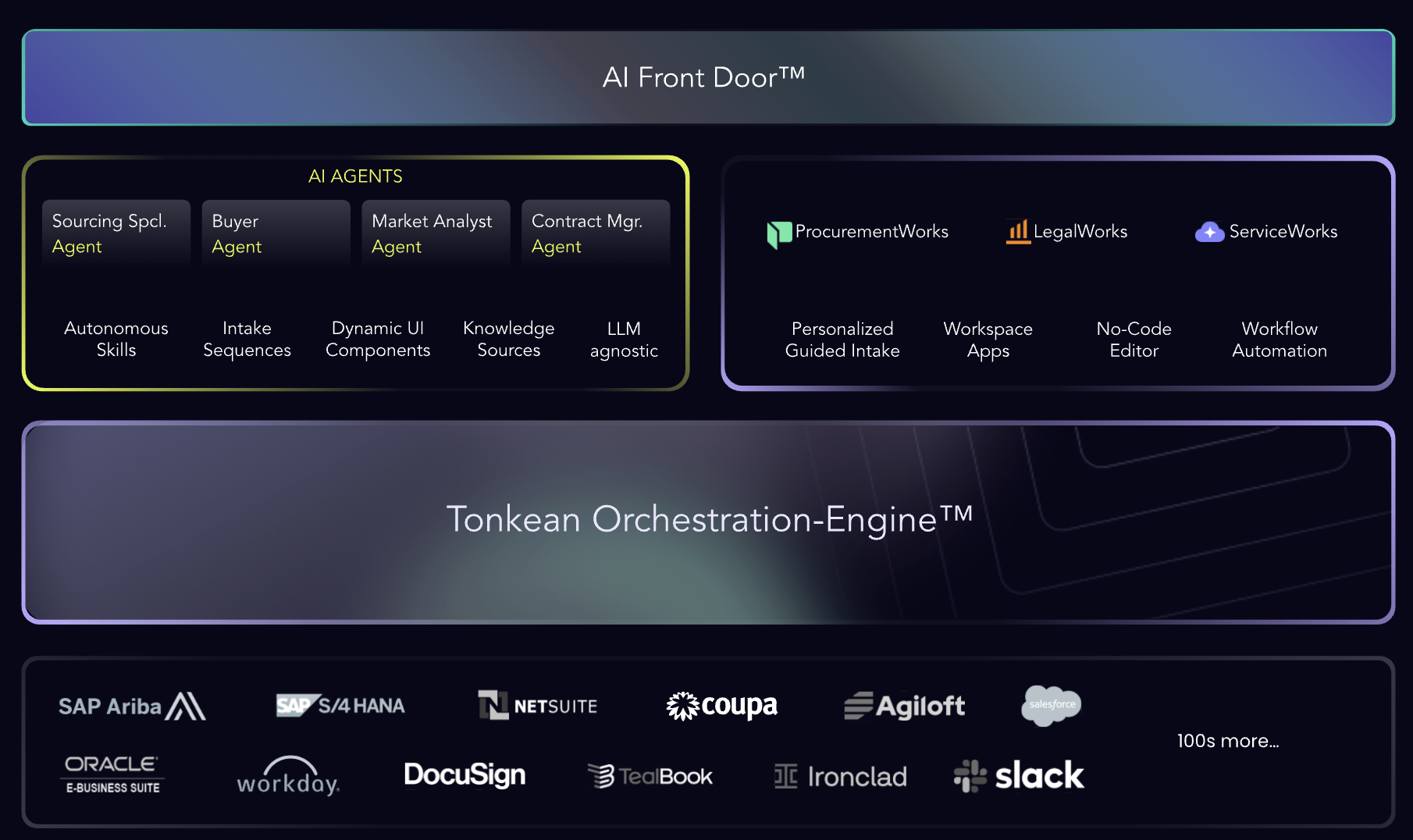
Process orchestration platforms, which allow internal teams to coordinate automated business processes and AI agents across teams and existing, integrated systems, are capable of capturing context at the point of decision of work, rather than only at the end.
But here’s the thing: only a particular kind of orchestration can do this. When it comes to equipping AI agents to conduct work autonomously, many orchestration approaches won’t work. In particular, orchestration solutions that are embedded in existing data systems, which only see limited, retroactive conclusion data, aren’t helpful here.
As Sagi writes: “Trying to build context graphs using the same technology that *caused the problem context graphs are supposed to solve* is a fool’s errand.”
The only way to capture context internally is to capture it while work is happening.
What you need, then, is process orchestration that operates not within the confines of any existing system, but in its own orchestration layer.
This is how orchestration platforms that are truly end-to-end—that is, not bolted onto an existing data system or suite—function: in their own layer, with the capacity to automate work across and above end-to-end processes. They capture decision traces as they occur, in real time.
As Jaya writes, “The orchestration layer sees the full picture: what inputs were gathered, what policies applied, what exceptions were granted, and why. Because it’s executing the workflow, it can capture that context at decision time—not after the fact via ETL, but in the moment, as a first-class record.”
The orchestration layer captures the reasoning, judgment, and coordination that happens between states, in real-time. It captures how work happens.
That captured context = context graphs.
This is how Tonkean works. As Sagi writes, “Tonkean sits above the organization, coordinating humans (and now agents) around policy and process, with both a bird’s-eye view and a first-person perspective. Through execution, it captures what happened, why, and the outcome.”
It’s for this reason that Tonkean agents have succeeded where others have failed, when it comes to working proactively and autonomously. With access to context, Tonkean agents learn from real workflows, not prompts. More usage leads to better judgment and fewer exceptions.
Tonkean achieves, in effect, what Bornet counsels in the HBR study: “Organizations need to ensure they have robust technical infrastructure with integrated data architecture across systems,” he says. “Along with strong security measures, and scalable systems in place before beginning agentic AI deployment.”
Autonomous, proactive agents will fundamentally reshape any domain where they take hold—just as we’re already seeing with coding agents.
But nowhere is the potential of autonomous AI agents to transform organizations more pronounced than in enterprise G&A.
Finance, Legal, Procurement, HR, and operations teams sit at the center of the enterprise. They manage risk, enforce policy, control spend, and keep the organization compliant and operational. Most pertinently, their work is inherently cross-functional, policy-driven, and exception-heavy. Most G&A processes remain manual because traditional SaaS can’t handle context, forcing humans to bridge the gaps.
Imagine a world where that can be done by AI agents.
Such agents would be a force multiplier of focus and creative freedom. “I don't want to do any source-to-pay work”, Dr. Elouise Epstein of Kearney said on a recent episode of Modern Business Operations. “What I want to do is the business of procurement.”
No other area of the enterprise represents such low-hanging fruit for AI agents to create real, impactful operational change.
At Tonkean, the new interest in context graphs feels like a full-circle moment.
Tonkean was founded to solve a core issue: the fact that SaaS is built around data, not humans.
The progress we’ve made correcting for that fundamental issue is what lets us, as Sagi put it, unlock the power of agents now: “years of human-first learning meeting an inflection point where AI is finally capable enough to act on it.”
This is the problem we built Tonkean to solve—long before AI agents entered the mainstream conversation.
To summarize:
So what’s the fastest path to autonomous AI agents in the enterprise?
Start with context graphs—built through an orchestration layer, beginning in G&A.
Want to learn more? Get in touch.