For decades, enterprise technology has been function-specific. Legal has its systems. Procurement has its systems. Finance, IT, security, HR, and engineering have theirs. This seemed to make sense, for a while. It was presumed to be the only way.
But more and more, the enterprise is waking up to the obvious problems this presumption compounds. Turns out, function-specific systems that were not designed to work seamlessly with one another wreak havoc on cross-functional work. Which, of course, is the type of work teams like procurement and legal are, at the end of the day, ultimately responsible for.
There's a touch of irony here. The tools legal and procurement teams have invested in to make their own work more efficient—including LLM subscriptions and personal AI tools, in addition to CLMs and ERPs and everything in between—mandate hours of inefficient work when used in tandem.
Consider something as ordinary as purchasing new software. What begins as a procurement request can quickly require legal review, information security assessment, privacy approval, budget validation, contract negotiation, supplier onboarding, and eventually payment. With no way to stitch together the tools implicated in this process, the task of completing the work falls inevitably on the human operators responsible for the outcome.
And even in the best of circumstances, that proves a messy, inefficient endeavor. Someone emails legal. Someone else submits a procurement request. Another person copies information into a CLM. Security asks questions that the requester already answered elsewhere. Procurement waits for legal. Legal waits for other teams. The requester asks everyone for status. Agents dispatched to do all this for us lack either the connection or the context required to do it reliably.
But there is a cleaner way. Exponentially more efficient, too. It starts with the orchestration layer.
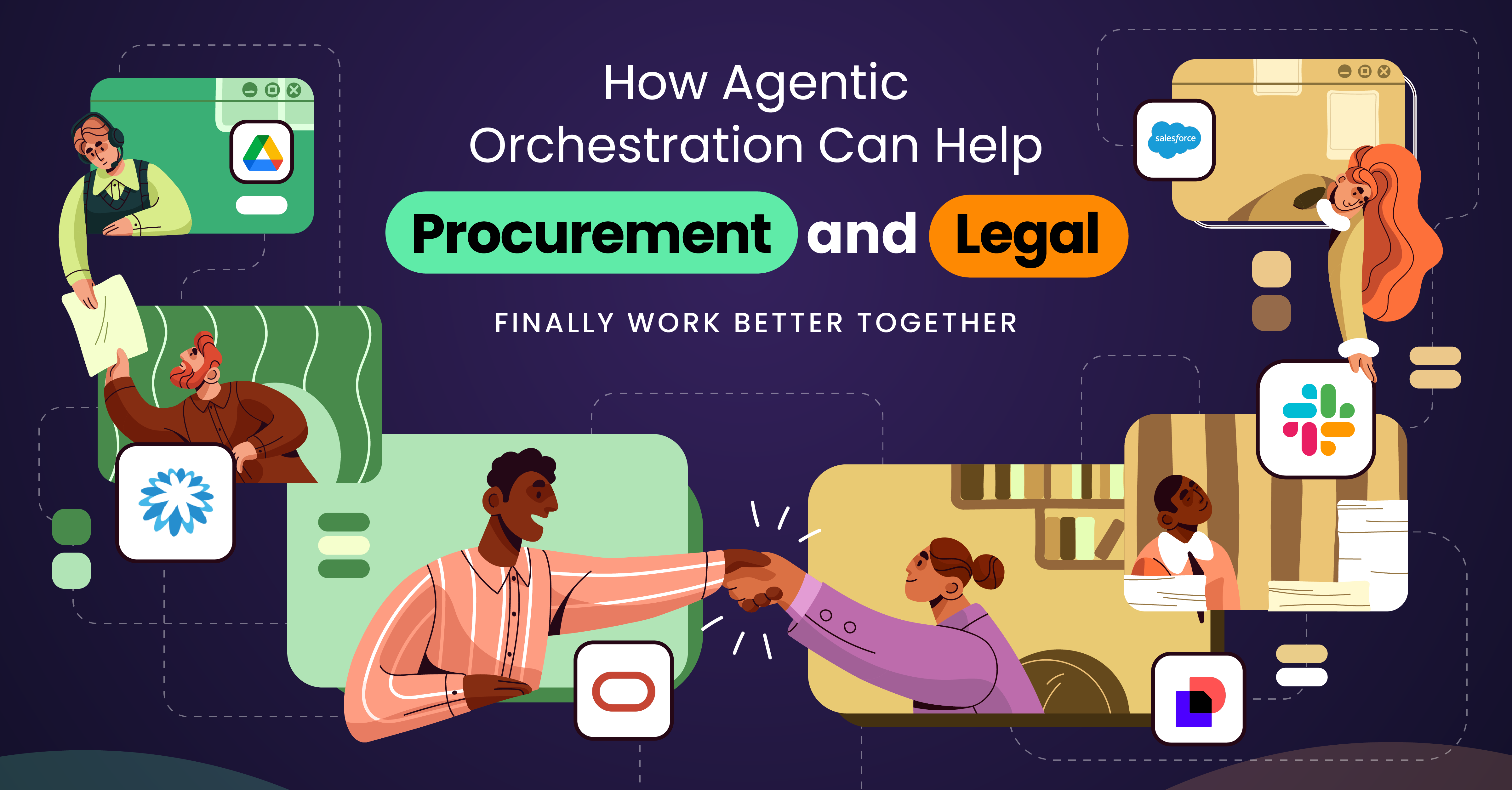
An orchestration layer sits in effect above the enterprise technology stack. It's a means of connecting every piece of technology, and of allowing human operators to coordinate work seamlessly and automatically across those tools, while leveraging agents. It connects the systems each function already relies on.
Agents managed through an orchestration layer benefit from context: insight into not only what is supposed to happen, but how and why. This allows them to automatically apply appropriate policies, engage the right stakeholders, determine correctly what needs to happen next in a given workflow when exceptions arrive—because they know why work happens the way it does—and then, finally, to go do it.
This is a fundamentally different way of conducting complex work. Often, when we think of collaborating with different departments, we imagine having to learn how to use their tools. With an orchestration layer, legal does not need to work inside procurement software, and procurement does not need to become proficient in legal technology.
Instead, the orchestration layer bridges the two, and manages traffic between them, and finally gives agents the context and information they need to do the cross-functional work across the systems, so humans can focus on the high-value work for which they were hired.
There are many obvious benefits to this. But making this transition from our old, siloed world to the orchestration world is also something of a broader, operational imperative.
Companies the world over are rapidly shifting from a traditional SaaS-based operational model—wherein tools are function-specific, and it remains incumbent upon humans to compensate for their limitations—to an agentic one. In this world humans act as orchestrators, coordinating autonomous agents across policies and connected systems end-to-end.
Here's an example of how this world works that you'll likely be familiar with. An employee wants to purchase a new $250,000 AI software platform that will process customer data. What looks like a simple request can easily turn into a hazardous maze of disconnected communication channels, duplicate work, missing context, and manual intervention.
Facilitating that same process using agents governed out of an orchestration layer changes the entire experience. First an agent can engage the employee in Slack, Teams, or an internal portal, gather the relevant details conversationally, and automatically determine which reviews are required based on company policy. Because they possess governed access to every piece of technology your organization uses, through the orchestration layer, separate agents can check whether the vendor already exists, surface overlapping tools or prior spend, route the contract to legal, trigger security and privacy reviews, and provide every team with the context already collected.
For legal, you receive not just a contract, but a complete review package—including supplier details, spend, data usage, business owner, timing, and policy exceptions—along with an AI-generated first-pass analysis identifying risky clauses, deviations from the contracting playbook, and issues that actually require attorney judgment.
If legal rejects an AI data-training clause, procurement immediately sees that blocker without having to chase for an update. If procurement renegotiates price or term length, those changes automatically flow back into the context available to legal and finance. From there, agents can monitor outstanding approvals, follow up with reviewers, escalate delays, answer status questions from the requester, and ultimately coordinate signature, supplier onboarding, purchase-order creation, contract storage, and renewal tracking.
The point is not to replace procurement professionals, lawyers, or other experts; it is to eliminate the manual coordination work that surrounds their expertise and stems from siloed tools.
Instead of people manually moving information between teams and systems, checking statuses, duplicating inputs, and figuring out what happens next, the orchestration layer manages that administrative load for them—turning what was once a fragmented set of departmental workflows into one coherent, end-to-end process… one in which collaboration between legal, procurement, and the agents they share becomes not some fanciful notion, but how work actually gets done.
And this is just one example. To get a sense of the potential of orchestration technology for teams like legal and procurement, extrapolate the above value across all your internal processes.
Getting started with orchestration does not require beginning with an enterprise-wide transformation, however.
In fact, a better approach is usually to start with one high-volume process where cross-functional friction is obvious.
Contract intake is one example. Supplier onboarding is another.
Wherever you start, however, once you start, we can pretty well guarantee you won’t end there. The shift previewed by the rise of orchestration is much larger than legal and procurement.
These problems exist everywhere: finance and procurement, HR and IT, sales and legal, security and engineering.
Companies have spent decades digitizing these individual functions.
Orchestration gives us an opportunity to rethink how those functions operate together.
See how Coupa intake and orchestration powered by Tonkean orchestrates legal and procurement work from intake through resolution—across teams, systems, and AI agents.