
Legal Operations is at a turning point. Leading analysts now argue that by 2030, the most effective legal departments will evolve from expert functional partners into what Gartner calls “legal intelligence architects”: teams that transform legal data, decisions, and workflows into a competitive advantage. Legal operations teams will lead that work. Legal operations orchestration is what makes it possible.
Over the past decade, legal ops teams have done what few other functions have managed as successfully: they digitized. They implemented CLMs, e-billing platforms, intake tools, matter management systems, and a growing layer of AI capabilities. They built a modern legal tech stack.
They leveled up. Legal, and legal ops by association, is usually labeled risk-averse and slow to adopt new technology. Legal ops is thought of as a cost center, rather than a business driver. But over the last decade—and even more so now, in the age of AI and AI agents, which legal ops teams have been leading adopters of—all that changed.
Last year my team conducted a survey of 300 senior enterprise legal operations practitioners across the world. We asked respondents to share, among other things, how they are currently using technology—from intake to CLMs to AI—inside their organizations. 60% said they were already using AI agents to conduct complex work internally. The number is almost certainly higher now.
And yet, much of the fundamental experience of legal work has not changed. Requests still arrive incomplete. Processes still vary depending on who submits them. Attorneys still spend an outsized portion of their time coordinating rather than advising. Business stakeholders still perceive legal—and legal ops by association—as slow and inefficient.
None of this has to do with the quality of the technology. Rather, it’s about the way we use technology—with what amount of cohesion, connectivity, reliability, and control; by what means we are able to transcend SaaS’s structural limitations.

How legal ops teams use technology has become a key determinant of how effectively they’re able to complete their essential work of enabling lawyers and the businesses. Yet few use their technology truly well. We remain boxed in by technology’s limitations: its siloes and hallucinations; its inability to bridge any Last Mile.
Legal Operations Orchestration technology provides a means for legal ops to transcend the traditional limitations of our tools and to use all of our organization’s components—its technology but also its people, systems, processes, policies, and AI agents—better together.
It creates a control and execution layer across the enterprise legal stack—coordinating how work is initiated, routed, governed, and completed in real time across people, system, policies, and AI agents. Rather than replacing CLMs, repositories, or e-signature tools, orchestration wraps around them—connecting them into a single, governed system of execution.
In practical terms, orchestration ensures that:
Orchestration solves for fragmentation. Consider a simple NDA request. In most organizations, it touches intake, CRM data, templates, approvals, document generation, and signature tools. Each piece exists. None are inherently connected. The burden of coordination falls on humans. Legal Operations Orchestration removes that burden. It ensures the process executes as a cohesive whole, while humans oversee.
What follows is a comprehensive guide for getting started with Legal Operations Orchestration. It’s been purpose-built for legal operations teams. Everything you need to know about the technology and topic—not only how to get started but why it’s needed, what it does, the context, the history, the future—in one place. Let’s begin.

The modern legal tech stack is, in many ways, a success story.
For years now, corporate legal teams, law firms, and legal ops teams all over the world have been adopting new technologies with an unprecedented sense of commitment and scale.
Gone are the days of data stored in filing cabinets and matter managed manually. Remarkably, in are the days of enterprise legal ops teams “Leading the Way When it Comes to AI.”
But, broadly, the legal tech stack is still a source of headache. It’s been several decades since we began using contract lifecycle management (CLM) systems, e-billing platforms, matter management tools, and eDiscovery software tools. We celebrated the new capabilities these tools delivered, yet we became boxed in by their siloes and inability to integrate seamlessly with the rest of the organization.
For these reasons, they did not seem truly capable of truly transforming the way legal ops goes about its core functions of service.
Legal Operations Orchestration is not only about orchestrating legal processes across tools. Rather, like the conductor of an orchestra, it puts legal ops in charge of all its moving parts, and empowers legal ops teams to finally, harmoniously weave them together and use them more effectively at the process level: people, policies, data systems, apps and agents.
Yet in many ways the most poignant and urgent problems it solves stem from tech. It addresses a structural issue plaguing every modern legal ops team across the world: the technology we use was not designed to be used together, in the manner of an orchestra. It was designed to create siloes.
Each tool solves a specific problem:
Individually, these tools work wonders at solving their specific problems. Collectively, however, they create more problems. Because they leave the coordination of work across systems largely a manual task.
This manifests in ways that every legal ops leader recognizes immediately:
Because the delays, risks, and inefficiencies that legal teams struggle with today do not come from the systems themselves. They come from what happens between them. A contract may be perfectly managed inside a CLM—but the intake that precedes it, and the approvals that surround it, often live elsewhere.
That is where cycle times expand and policy enforcement weakens.
This is why, despite significant investment, many legal teams still face:
What’s missing is connection. Not just integration at the data level—but coordination at the process level and control over how exactly, down to the agent and the atom, that coordination is facilitated.
Legal Operations Orchestration provides that.
Today, many enterprise legal ops teams are embracing the potential of orchestration for finally transcending technology’s longstanding limitations. But a good many others remain stuck.
Over the last several years, we’ve spent a lot of time investigating the legal ops landscape. We’ve conducted surveys of enterprise legal ops teams. We’ve interviewed legal ops executives. We’ve done case studies on enterprise teams leading the way into this new frontier where technology finally truly works for humans, as opposed to forcing humans to work for technology.
In sum, the data we’ve collected provides an excellent starting point for understanding precisely what challenges remain most pertinent to the modern legal ops team—and exactly what kind of role Legal Operations Orchestration will play in helping us all move boldly into the next era of legal ops as a discipline.
The biggest and perhaps most critical foundational step any enterprise legal ops team can take in their journey towards taking back control over the technology—with the ultimate goal, one day, of eliminating manual work for lawyers and legal ops teams alike on the back of autonomous AI agents—is fixing intake.
Every legal process begins with a request.
But in most enterprises, that starting point is fragmented, inconsistent, and largely uncontrolled.
Requests come through email, Teams, spreadsheets, and informal conversations. Even when intake tools exist, they are often bypassed or inconsistently used. Information is incomplete. Context is missing. Legal teams spend significant time simply clarifying what is being asked before any meaningful work can begin. Employees not knowing where to start with intake slows them down. And of course, it slows down legal and legal ops teams, too. Because if the entry point to legal is unstructured, everything that follows becomes reactive.
So, what’s the best way for legal ops teams to manage this critical first impression and entry point into the process experiences they provide stakeholders through orchestration?
On this, consensus is pretty clear: an AI Front Door.
Gartner describes this shift as AI-Embedded Intake and Self-Service—embedding legal support directly into business workflows so employees receive guidance, risk assessment, and escalation at the point of need. Tonkean calls this the most important first step in legal transformation.
A quality AI Front Door provides a single, intuitive, and highly intelligent entry point for requesters and for all employees’ interactions with legal—both members of the legal team and legal agents. Employees can start every and any request by simply bringing it to the Front Door, which looks and feels like a chatbot.
But Front Doors worth their JD are far from just a chatbot. Tonkean’s AI Front Door, for example, works as the traffic operator for your organization’s use of AI, ensuring new requests flow seamlessly to the right specialized agents, humans, and workflows while preserving full context. Employees can open it from inside the tools they already use—Microsoft Teams, Slack, email—and for simple requests, it will give employees what they need instantly. When requests necessitate a larger process, the Front Door will determine the right agent or workflow to point the user towards.
It is, in this sense, an example of orchestration in action. Instead of static forms, an AI Front Door creates dynamic, guided experiences:
Still, for as crucial as a sound, structured, intuitive means of facilitating legal intake is to the health and performance of your legal operations… fixing intake is only a starting point.
A well-designed intake form may capture all the necessary information for a contract request. But what happens after submission?
In many organizations, the answer is still: manually. This creates a structural disconnect. The front end of the process is standardized. The execution layer remains fragmented. Legal teams still spend time triaging, routing, and coordinating. Data still needs to be re-entered into downstream systems. Stakeholders still operate across disconnected tools.
However, if your organization’s moving parts are all connected through an orchestration layer, once a request enters through a structured, intelligent front door, it will immediately trigger orchestrated workflows across the legal stack—while minding, of course, the guardrails of your policies and governance structures. This changes everything. For example:
A sound strategy, as it pertains to intake: Fix intake; control everything after.
Let’s say you’re ready to get started with Legal Operations Orchestration. You’ve got an AI Front Door with which to fix intake. You’ve got AI agents ready to begin automating legal work on your team’s behalf.
What next?
One mistake legal ops teams make is losing themselves in the ocean of acronyms, vendors, and technology types that present as the solution.
Or, conversely, they make the opposite mistake, and pool all automation types—from task automation tools to enterprise-grade orchestration platforms—into one monolith technology category.
Automation capacities exist on a spectrum, in a taxonomy of distinct, well-defined technology categories. They are as follows:
Each of these technology categories has value. But it pays to know the differences between them.
Workflow automation, for example, is highly effective within a controlled environment. It can generate documents, send notifications, or move data between systems.
But it assumes a predictable sequence of steps. Legal work rarely follows such linear paths. A vendor contract might involve procurement, legal, finance, and compliance—each with different systems, requirements, and decision points. The process adapts based on risk, value, and context.
This complexity cannot be managed by rigid, isolated workflows. It requires coordination across workflows. It requires agents with tightly-governed access to your internal systems and possessed of the kind of context required to navigate edge-cases.
Gartner predicts that by 2030, legal teams will shift from bespoke legal guidance toward dynamic workflows designed to scale technology, AI, and hybrid human-agent work. In Gartner’s view, legal’s ability to operationalize AI will depend not just on adopting new tools, but on codifying decision criteria, standardizing high-value workflows, and embedding governance directly into execution.
Task automation can complete isolated actions. Workflow automation can coordinate a predefined sequence of steps. But dynamic legal workflows require something more: a control layer capable of adapting in real time—applying policy, routing decisions, coordinating stakeholders, and governing AI agents across systems.
For that, you need orchestration.

Where do contracts fit into all this?
Contracts—and even more so the obligations they contain—are central to how legal ops teams manage risk, cost, and relationships.
But the means by which most enterprise legal teams manage contracts today hasn’t kept pace with how work actually happens inside most organizations.
Traditional CLMs move documents through approval. They store contracts. But they don’t offer much in the way of flexibility, interoperability, or post-signature governance—of helping ensure a contract's terms and obligations are honored downstream.
Contracts get signed, but then they get siloed—and the obligations stipulated in them are not reliably enforced, tracked, or operationalized.
This is a different version of the same problem that haunts so many other aspects of enterprise G&A work today. And the impact on work quality, to say nothing of efficiency or experience, is just as drastic.
Enterprise legal ops teams need a way of folding contracts into their larger orchestration strategies. Effectively, they need a way to automate the task of honoring obligations and managing post-signature governance through orchestration at the process level.

Through orchestration and legal AI agents, now, they can.
Tonkean Contracts Hub, for example, brings intelligence and structure to every stage of the contract lifecycle. Unlike traditional CLMs that focus on linear workflows and document storage, Tonkean uses AI agents to proactively facilitate the work of contracts intake, drafting, review, and approvals… while continuously tracking obligations, renewals, and compliance after signature… so legal intent is enforced long after the contract is signed.
AI agents interpret contract terms and orchestrate actions across legal, finance, and procurement systems—without ripping out existing CLMs or rebuilding workflows.
There’s much innovation—both agentic and otherwise—happening inside the contract space right now. Regardless of what tool you use to manage the contract lifecycle, however, it pays above all to treat contracts like every other part of your operations. Alongside teams, tools, policies, data systems, and AI agents, they should be thought of as a part of your orchestra.
Orchestration puts legal ops teams back in control of the parts of legal work that have always been implicit, rather than designed—decision rights, conditional logic, accountability, escalation, proof, and, yes, obligations.
The AI, AI agents, and agentic orchestration changed everything for every enterprise G&A function—but in few other departments is this more true than in legal ops.
Here, finally, was something new: intelligent technology that could work alongside legal and legal ops professionals not as a chatbot, not as but another UI, but in the manner of a networked colleague.
And legal ops was quick to recognize the potential. As we mentioned above, in our recent survey of enterprise legal ops professionals, 60% said they were already using AI agents to conduct complex work internally.
Today, large language models can extract clauses from thousand-page contracts in seconds. AI agents can draft NDAs, answer employees’ policy questions, and proactively elevate risks in even less time.
Combined with agentic orchestration platforms, which allow legal ops teams to automate workflows powered by agents across teams and technology systems, AI agents can help legal teams deliver services that are faster, more consistent, and better aligned with the business than ever before.
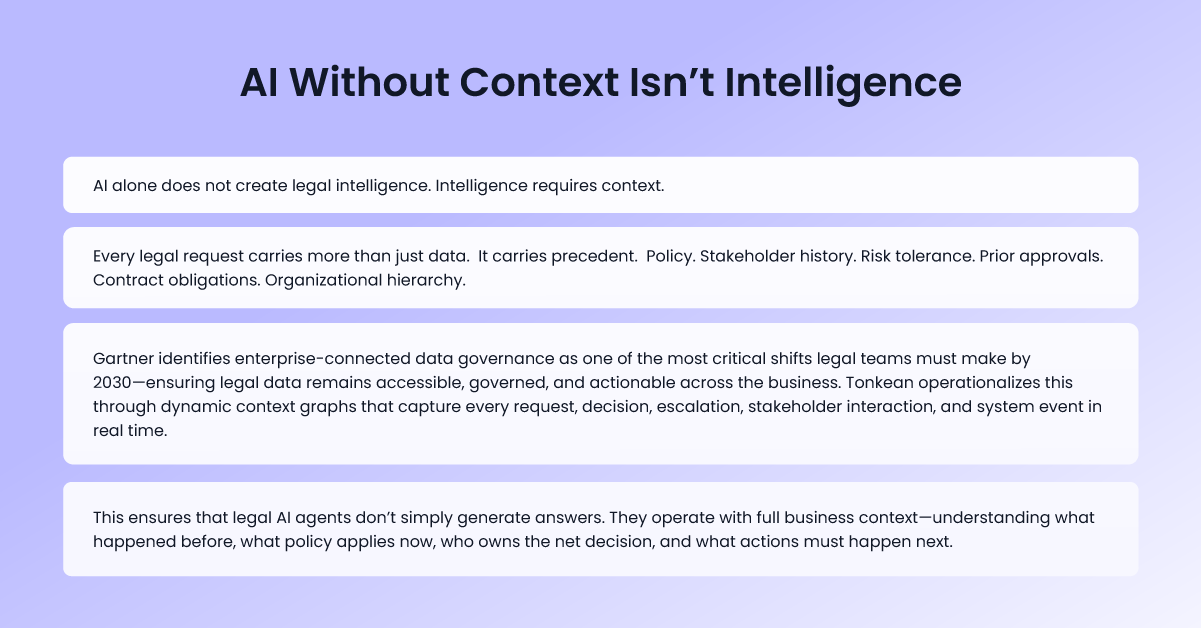
Though that might even be conservative. In truth, what AI agents and legal agentic orchestration is poised to do is fundamentally transform the texture and capacity of legal ops forever.
Orchestration, however, is once again the key.
What does it take to trust AI agents to complete complex work autonomously inside your organization? The answer, turns out, is readily available—we’ve been working on it for roughly the last one hundred years—and, beyond that, totally achievable.
AI agents are intelligent entities, which makes them comparable in many ways to human employees, the original intelligent entity.
To complete complex work autonomously AI agents need roughly what humans need in order to do the same thing.
The orchestration layer is, in its most basic sense, a means of providing both humans and legal AI agents precisely this. With agentic orchestration, legal ops can coordinate workflows across humans and agents in accordance with policy and organizational hierarchy—all while maintaining control.
The key, once again, is connectivity. Getting truly transformative value out of legal AI agents, much like improving the performance of your legal operations as a whole and finally succeeding in reducing manual labor for lawyers, comes down not to accumulating more tools, but finding ways to better connect the tools we have.
The firepower of the technology is no longer the bottleneck. Rather, silos, poor experience, and inadequate integrations are.
The solution here is connection and coherence. The legal and legal ops teams that win the future—that succeed in realizing AI’s promise to revolutionize the way we work for the better—will be those who succeed in orchestrating work seamlessly and autonomously across tools, teams, and tightly-governed AI agents.
It’s the next step. But it’s also possible right now.
It’s official. Legal ops is moving into its orchestration era.
Over the last decade, legal ops have made great strides in digitization, adopting CLMs, matter management, e-billing, intake tools, contract repositories, and now AI.
Those investments moved legal ops forward.
But even the most modern legal tech stacks still break down in the same places: between systems, between teams, between decisions, and increasingly, between humans and AI.
The question now: what’s next?
Here’s what we think: the future of legal ops—those legal ops teams who succeed in realizing AI’s promise to revolutionize the way we work for the better—will be defined not by those legal ops teams that continue accumulating tools, but, rather, learn how to use better together the resources (technological, agentic, and human) they already have.
That comes down to connection, control, coherence—and orchestration.
Ready to get started? Check out Tonkean LegalWorks here.