.png)
You read that right.
In Tonkean’s recent survey of 300 senior enterprise legal operations practitioners, The State of Legal Operations Tech Stack, we asked respondents to share, among other things, how they are currently using technology—from intake to CLMs to AI—inside their organizations.
What they shared went a long way towards disproving certain longstanding notions about legal operations that I—over my time helping lead legal ops inside organizations like ServiceNow, Snowflake, and now Tonkean—have long suspected are due for revisiting.
Legal, and legal ops by association, is usually labeled as being risk-averse and slow to adopt new technology. For being a cost center, rather than a business driver. But in the age of AI and AI agents, that’s all changing.
That was perhaps the central findings of our survey: legal ops teams are leading the way inside the enterprise when it comes to both experimenting with AI and AI agents.
For example, a full 60% of enterprise legal operations teams are already using AI agents to conduct complex work internally.

And they’re learning a lot about what makes for sound agent-implementation strategy in the process.
This is remarkable in and of itself. Certainly, if you would have asked people around the enterprise in the wake of the release of ChatGPT, nobody would have guessed that it would be legal ops that was producing the key learnings about how to make the best use of this transformative technology. Yet that’s exactly what’s happening.
What matters when it comes to getting the most out of any AI-native technology—be it CLMs, chatbots, or cross-functional AI agents—is not how much firepower is packed into the technology itself, nor how much of it you accumulate.
What matters is whether you’re able to connect it all together.
For example, a CLM that uses AI to extract obligations from a contract is not very useful if it can't use that data to automate business outcomes in other systems.
But when it can—that’s when you begin to change the efficiency and effectiveness with which you operate org-wide and at scale.
So how do you do that?
Legal ops is cohering around an answer.
Our survey found that the leading barrier to broader AI adoption in legal operations is a lack of integration across tech stacks. 46% of respondents cited implementation complexity, caused by poor integration, as their primary challenge when it comes to adopting AI.
Unsurprising, then, that when asked about their most desired AI capability for 2026, 61% cited seamless integration across internal systems.
But here’s the crux. When asked to cite which pieces of AI-powered technology they’re planning on investing in next, in order to bridge the gaps in the AI implementations thus far, a majority of respondents replied, “Improving orchestration.”
AI agents are goal-oriented systems capable of understanding context, making decisions, collaborating with other agents, taking action within established rules, and otherwise completing complex work ongoing and overtime.
The impact of AI agents in legal ops varies, but one thing AI agents are already doing is cutting down on the amount of time the legal team spends on manual work centered around data.
“It’s jarring to see the results of a time audit because you will see that very impactful, brilliant people, that could be focusing on big picture company issues, are spending time manually extracting information going from system to system,” said Frances Pomposo, former Senior Director of Legal Ops and Technology at Cisco, in our recent Getting Started with AI Agents in Legal Webinar. “They are doing things that could be orchestrated by an agent or a tool.”
This is where orchestration comes in.
To be sure, legal ops’ early use of AI agents has taught enterprise operations teams much about what AI and AI agents are already very good at. Perhaps more importantly, however, it’s also taught them what else in the way of infrastructure, governance, and integration AI agents need in order to produce truly transformative work.
AI agents cannot complete meaningful work totally on their own or in a silo. In order for them to act as anything more than really smart chatbots, you need to have a certain amount of piping and support infrastructure in place.
Among other things, you need to ensure your various tools, teams, departments and data environments are all connected, such that you can orchestrate agents across them, and such that those agents can conduct truly cross-functional work on their own.
Without such integration, even the most powerful AI agent becomes but another fragmented piece of an already fragmented tech stack.
Orchestration technology, through end-to-end integrations, enables teams to coordinate automated business processes across departments, data systems, and application environments. Positioned effectively above your organization’s technology stack, orchestration platforms serve as a connective layer for your entire organization.
Through no-code orchestration platforms, functions like legal ops can build and deploy processes that seamlessly “orchestrate” all their organization’s component parts—that is, their unique mix of people, data, and tools.
Agentic orchestration can be thought of as orchestration that empowers enterprise teams to include in this mix of manipulatable components specialized, autonomous AI agents.
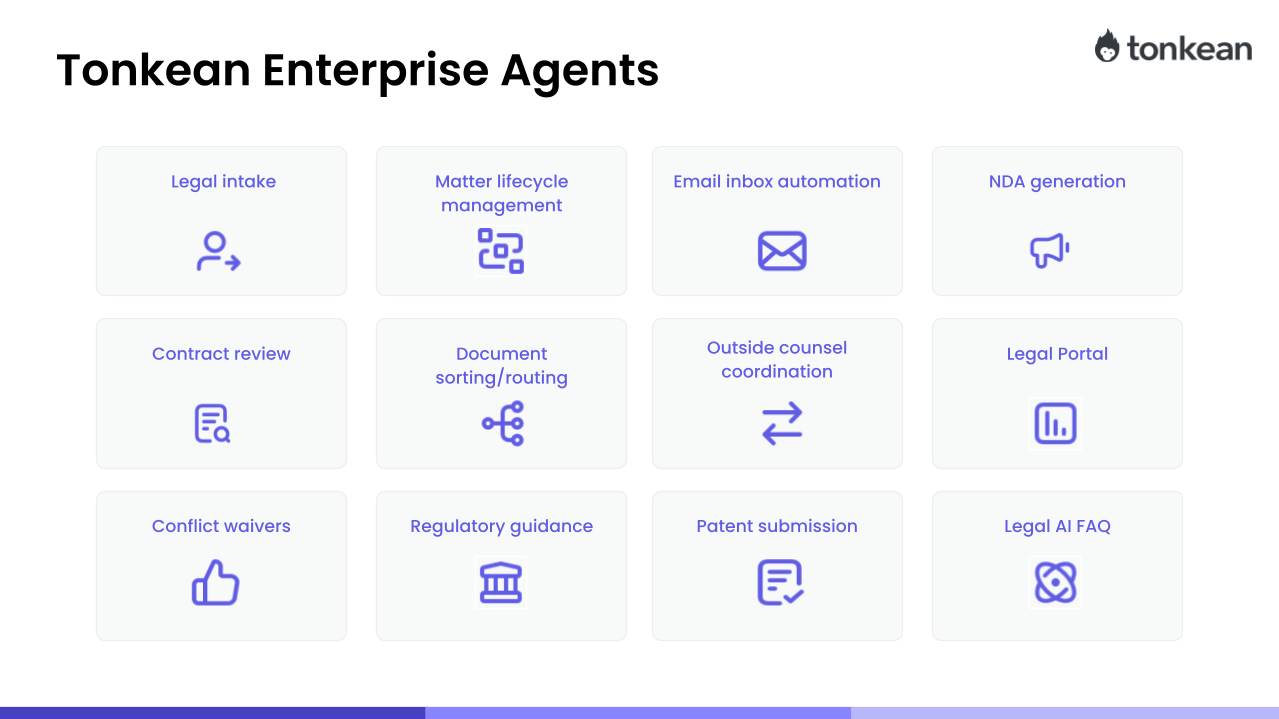
The benefits of orchestration for functions like legal ops are immense. In the context of AI agents, they allow you to do things like provide employees access to specialized agents wherever they already work—Slack, email, Teams, etc.
Further, they allow you to deploy AI agents to conduct complex work that’s truly cross-functional on their own—as in, not just in the silo of one UI, and not only when explicitly prompted in a chat window.
The benefits of orchestration are more pronounced the more complex the operational environments you’re working with. And the operational environments most legal ops teams are working with have never been more complex.
According to our survey, on average, legal teams are interfacing with eight to ten separate legal systems daily. 54% of respondents said stakeholders have to log into three or more separate systems just to complete a single request.


“We have for a long time had a lot of built for purpose types of technologies within legal, and it’s created a very fragmented infrastructure,” said Jeffrey Franke, Co-founder & General Counsel of LegalOps.com in The State of the Legal Operations Tech Stack webinar. “Many of these tools are very good at what they do, but they are disparate … It’s a world people want to move away from.”
Connecting disparate tools such that you can create more people-friendly process experiences—as well as orchestrate AI agents across working environments—is something agentic orchestration does very well.
We know this, in part, because we see it at Tonkean. True orchestration has to be holistic. It has to unify data, tools, and AI agents across the entire organization.
For our part, this is precisely what we’ve built Tonkean’s agentic orchestration platform to do. And our partners are seeing the benefits.
“Tonkean becomes an evangelical technology for the legal department because it truly enables the entire business,” said Connie Brenton, Co-founder and CEO of LegalOps.com.
Orchestration has important downstream benefits when it comes to safety, governance, and risk.
To use AI safely, legal teams need governance structures with which to define how AI agents act, what data AI agents can access, how human workers collaborate with AI, and so on.
Orchestration gives you the ability to put structure around intelligence. It allows you to do this at the agent level, where you can build nondeterministic, rules-based guardrails pertaining to access and autonomy into the agents themselves.
You can do the same at the process level, ensuring both your AI and your employees are always operating within a unified framework with oversight and governance.
Orchestration, in other words, gives legal ops not only connection, but control.
Available evidence suggests that the future of AI in legal will be shaped by legal ops teams who prioritize connecting AI agents across tools and systems, such that those agents can proactively and autonomously conduct complex work safely.
The teams that succeed won’t be the ones that use the most AI; they’ll be the ones that orchestrate it best.
It bears repeating: these lessons are not coming out of the IT department. They’re coming out of legal ops.
This is what I was recognizing years ago at Snowflake and ServiceNow. It’s what nearly everyone I’ve worked with across enterprise legal ops teams has suspected for some time. Legal ops has elevated. It’s no longer an overlooked support function. It’s becoming one of the most advanced functions inside the enterprise. And in leading the way on AI agents, it’s already proven essential.
Want to learn more about Tonkean’s LegalWorks platform? Click here.