In-house legal teams have never had more technology at their disposal. Yet, they have rarely felt more stretched. Technology, in fact, exacerbates the issue.
Intake requests arrive scattered across email, Slack, Teams, and hallway conversations, and attorneys still spend hours on triage, status updates, and copy-pasting data between systems—their CLM, their matter management systems, their e-billing tools. None of which integrate easily with each other.
And AI agents? Few organizations have moved from personal to operational implementations.
The numbers bear this out. In Tonkean's State of the Legal Technology Stack 2026 survey of 300+ enterprise legal and legal ops leaders, only 25% said their legal tech stack is adequately integrated.
At the same time, among the 60% of legal teams that’ve already deployed AI agents internally, 61% say better system integration is their next AI investment.
That gap has real business consequences. Disconnected systems create manual work, limit visibility into legal demand, and make it harder to scale automation across the enterprise. As legal teams face growing pressure to demonstrate the value of their technology investment, simply adding more tools isn’t the answer. Making existing investments work better together is.
Which is to say nothing of the increased risk. Ask any given enterprise legal team whether they feel confident deploying AI agents internally right now, and the answer you’re likely to hear is “No,” in large part because they doubt whether they’re able to control them operationally.
The value of any technological investment stems not from what the technology can do, but how your organization is able to leverage it.
Hence the rising interest among in-house legal teams in process and agentic orchestration, technology that promises to put enterprise teams in control over their unique mix of tools, systems, and data—such that they can automate and “orchestrate” complex work across them reliably. This technology represents not another point solution, but a way to use your existing point solutions and resources better together.
The best legal agentic orchestration platforms function as a kind of control layer that sits above your organization and technology stack—and comes complete with comprehensive controls, context graphs, and audit trails.
These days, two platforms come up most often in orchestration evaluations: ServiceNow Legal Service Delivery and Tonkean LegalWorks. Both are serious, enterprise-grade options. They’re also very different.
ServiceNow Legal Service Delivery (LSD) extends ServiceNow's IT service management platform into legal. It packages legal request management, matter management, and a set of practice apps (investigations, legal holds, conflicts of interest, simple contracts) inside the Now Platform, with generative AI from ServiceNow's Now Assist layer, recently rebranded ServiceNow Otto.
Tonkean LegalWorks was built as an orchestration layer from day one. Rather than asking legal to move into a new system of record—or forcing the employees legal serves to do the same—it sits across the tools legal and the business already use, and coordinates intake, triage, AI agents, and workflows end-to-end.
In short: ServiceNow extends its enterprise platform to support legal service delivery. Tonkean provides an orchestration layer that connects legal teams, AI agents, and existing enterprise systems, allowing organizations to modernize legal operations without replacing the tools they already rely on.
Let’s break down what that difference looks like in practice.
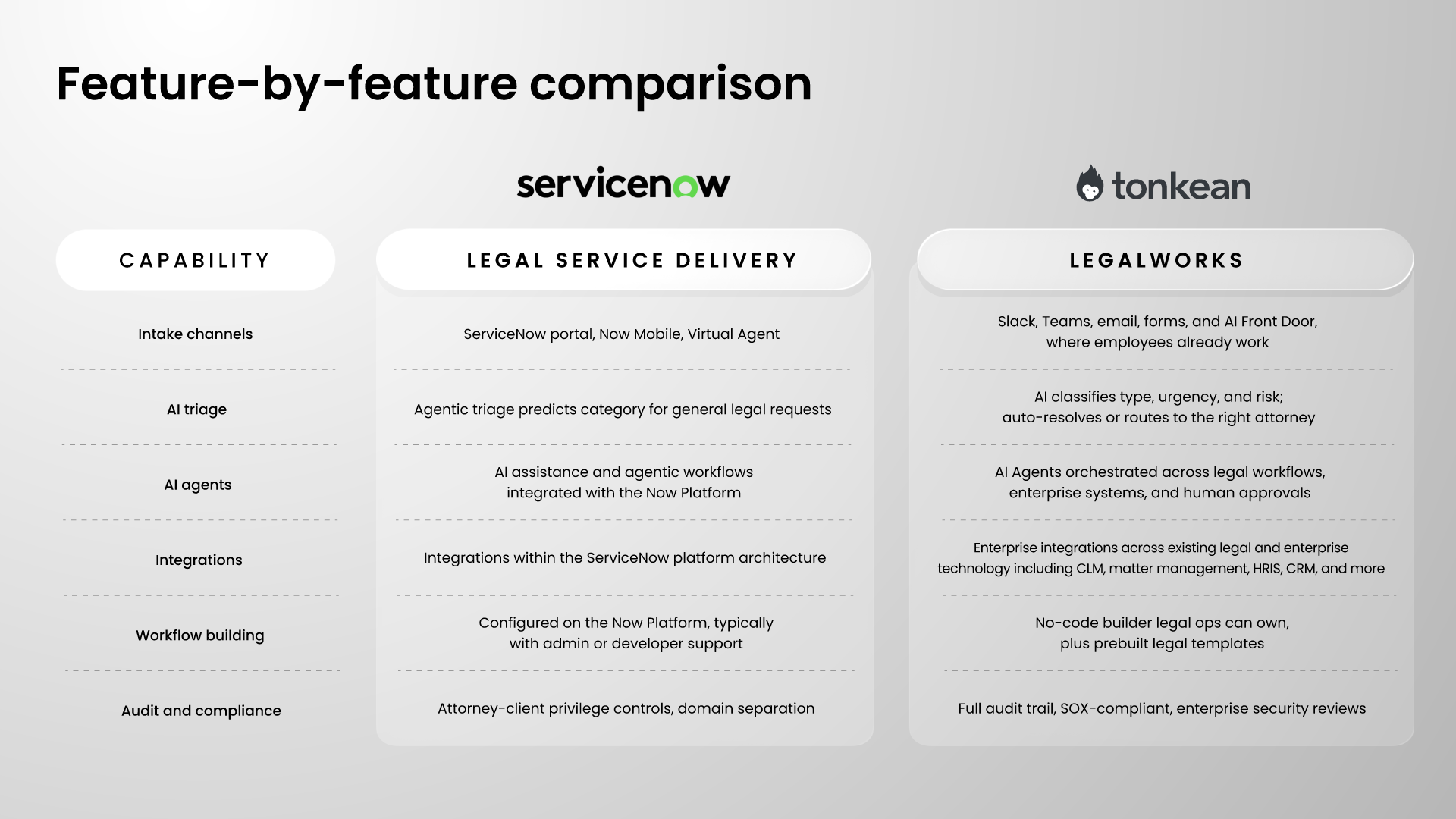
ServiceNow offers legal intake through its employee portal, mobile experiences, and conversational interfaces, with options to integrate into other enterprise tools. . For organizations already standardized on ServiceNow, this can provide a consistent employee experience. The consideration for legal teams is how much configuration and ongoing platform administration are required to deliver intake experiences across the systems employees use every day.
Tonkean takes the opposite approach. Requesters are empowered to send requests to legal from Slack, Teams, and email—wherever they already like to work—through Tonkean's AI Front Door, which turns those conversations into structured intake. No new login, no training, no lost emails. By reducing the need to learn a new process or navigate another system, Tonkean helps remove barriers to adoption and makes it easier for employees to engage legal through approved channels.
ServiceNow's agentic triage workflow analyzes general legal requests and predicts the appropriate legal category. That is a useful first step.
Tonkean focuses on reducing the amount of work that reaches legal in the first place. AI-powered triage identifies request type, urgency, and risk, then uses legal-defined policies to determine the next action. Routine questions can be answered automatically, standard requests like NDAs and SOWs can move through automated workflows, and more complex matters can be enriched with relevant enterprise data before reaching the appropriate attorney. The goal isn’t simply to organize legal demand. It’s to resolve more of it without unnecessary manual intervention.
ServiceNow's offers AI-powered capabilities that support legal service delivery, including summarization, knowledge retrieval, triage, and workflow automation within the broader Now Platform.
Tonkean's enterprise agents are built to do the work across functions and systems. The AI NDA Agent, AI Contract Manager Agent, Legal Mailroom Automation, and Legal Email Triage agents carry context between systems and process stages, taking high-volume work off attorneys' plates instead of just describing it to them. The distinction is the ability to coordinate AI-driven actions, human approvals, and enterprise data across the systems involved in completing the legal work, rather than treating each task as an isolated interaction.
This is the core difference. ServiceNow LSD is strongest when legal work stays inside the Now Platform. Its matter management, document storage, and practice apps are designed to become legal's system of record.
Tonkean is designed to connect, not replace. It orchestrates across the CLM, matter management, e-billing, HRIS, and CRM tools you already pay for. For legal teams managing investments across CLM, matter management, e-billing, HR, and other enterprise systems, this approach helps preserve existing technology investments while connecting the processes and data that span them. Rather than introducing another disconnected layer, Tonkean helps turn the existing technology stack into a coordinated legal service delivery ecosystem.
On ServiceNow, legal workflows are configured on the Now Platform, which typically means relying on ServiceNow admins or developers and competing for space in IT's backlog.
Tonkean's no-code builder is made for legal ops. Teams start from prebuilt Legal Intake, Triage, and Coordination templates, then adapt them themselves. As one legal ops leader put it, the no-code approach lets teams "try solutions independently and see ROI immediately."
Both platforms take governance seriously. ServiceNow offers attorney-client privilege restrictions and domain separation. Tonkean provides a full audit trail of every request, decision, and agent action, is SOX-compliant, and passes enterprise security and privacy reviews, so legal can adopt AI agents with confidence.
Tonkean abides by five fundamental principles of enterprise agentic governance.
1. Deterministic guardrails at both the process and the agent level
2. Enforce least-privilege access everywhere
3. Human-in-the-loop
4. Complete, non-repudiable audit trails
5. Enterprise-grade security, compliance, and data protection underneath it all
As a result, Tonkean AI agents make the leap from AI as a tool to AI as governed infrastructure.
You can read more about our approach to security and governance here.
ServiceNow LSD is a strong choice for organizations that want legal fully consolidated inside an existing ServiceNow investment. But for legal teams whose goal is agentic orchestration, Tonkean LegalWorks has the edge on the things that matter most:
The next era of legal operations will be defined by how effectively organizations connect their people, processes, systems, and AI agents to deliver better business outcomes.
For organizations already standardized on ServiceNow, extending that platform may be a logical approach. But for legal teams looking to maximize existing technology investments, accelerate intelligent self-service, and orchestrate complex workflows across multiple systems, Tonkean LegalWorks offers a compelling alternative.
The question isn’t simply which platform can manage legal requests. It’s which approach gives legal the flexibility, control, and scalability to transform how work gets done.
Ready to see agentic orchestration in action? Request a LegalWorks demo.