Legal teams face more pressure than ever to get it all done.
The pressure is coming from every direction. Work volumes are rising. Regulatory environments are growing more complex. Business teams expect faster answers. Clients need answers even faster. Business leaders need legal teams to become more strategic, efficient, and innovative—all without a corresponding increase in resources.
Modern intake, automation, and orchestration technology can help.
At its best, this technology can fundamentally transform the way legal works. It does so by giving legal more control over how work moves across an organization. It enables legal to meet users where they are, providing one clear, intuitive place to get legal help while also making legal accessible from the systems and environments where employees already work. It enables legal to work smarter, with AI agents and Front Doors that operate dynamically, autonomously, and with context.
Say an email comes in. Intake and orchestration can intelligently triage the request, determine which policies and processes apply, and route the work to the right workflow, agent, human, or self-service system.
But that is—or should be—just the start.
The best intake, automation, and orchestration platforms can automate the administrative work surrounding legal expertise: chasing missing information, sending reminders, creating matters, assigning owners, requesting approvals, generating documents, updating records, answering status questions, and escalating exceptions.
And it can orchestrate the work for which legal is responsible, but which happens beyond legal itself. That matters. Legal work is inherently cross-functional. A contract request might involve sales, procurement, finance, privacy, security, and IT, in addition to legal. An employment issue may start in HR and require input from legal, management, outside counsel, and finance. Compliance work routinely depends on information and action from teams across the business.
Historically, legal has had to manually bridge the gaps and handoffs between systems and teams. Now they don’t have to. The best intake and orchestration platforms can coordinate those dependencies across departments and the technology stack. Instead of asking lawyers and legal ops professionals to manually move information between systems and keep every stakeholder aligned, intake and orchestration can connect the applications each team already uses. Agents carry context between process stages, trigger downstream actions, and keep work moving.
The impact can—again, should be—transformative: dramatically shorter cycle times, less manual work, better compliance and visibility, better experiences for business users and more time for attorneys to focus on work that actually requires legal judgment. Use these tools right, and you also create the infrastructure for more sophisticated AI. Once processes, systems, policies, and data are connected, AI agents can operate more autonomously and reliably—gathering information, applying rules, navigating exceptions, taking approved actions, monitoring progress, and escalating issues when human expertise is required.
The problem is most legal teams are still operating much as they always have—and many intake, automation, and orchestration tools are built around that same model. They maintain siloes, provide little connective tissue across teams and systems, and leave significant manual work behind.
Requests still arrive through email, Slack, Teams, forms, meetings, and spreadsheets, and legal still tries to triage them all manually. Employees circumvent official legal processes because they are hard to find or inconvenient to use. Lawyers chase requesters for information that already exists somewhere else in the organization. Legal ops teams manually assign matters and update systems. One department completes its part of a process, and someone has to tell the next department it’s their turn. And the complexity compounds whenever more teams or systems become involved.
Many legal intake and workflow platforms solve only part of this problem. They may provide a better form but still require employees to log into a legal system. They may automate a workflow inside their own platform but struggle to coordinate work across the rest of the enterprise. They may connect to other applications, but those integrations can still leave humans responsible for reconciling information and managing handoffs.
When evaluating this market, legal teams should look beyond the question of whether a platform can build forms or route requests. The platforms with the greatest potential to transform legal operations will be able to:
This creates a more coherent and capable operating environment for legal work—one where employees know how to engage legal, routine work moves automatically, systems communicate, cross-functional processes require less manual coordination, and legal professionals spend more time applying their expertise.
There are now a growing number of platforms promising to help legal teams get there. They vary substantially, however, in what they are actually designed to do, how deeply they integrate with the rest of the enterprise, and how far they can take you beyond basic intake and workflow automation.
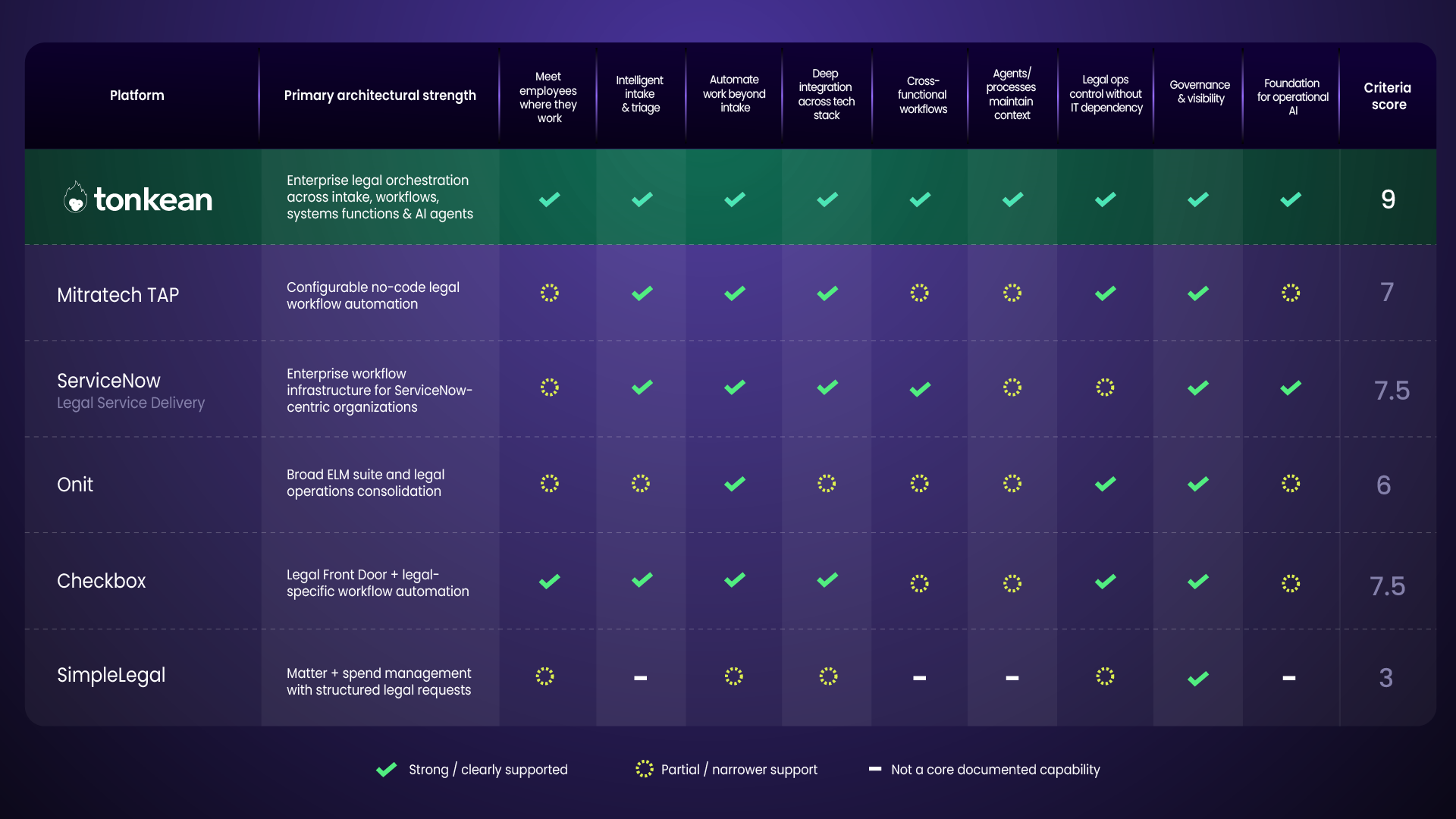
To help, we put together this overview of five of the most relevant legal intake, automation, and orchestration platforms for enterprise in-house teams—what each does best, and what you should know before you buy.
Best for: Enterprise legal teams that need intake, automation, and agentic orchestration across systems and functions
Tonkean takes the broadest approach of the platforms on this list, extending beyond legal intake and workflow automation to orchestrate legal work across systems, teams, and AI agents.
Rather than treating intake as the endpoint—or asking legal to move every process into one new destination—Tonkean functions as an orchestration layer across the enterprise technology stack. Its LegalWorks solution combines an AI Front Door, intelligent intake and triage, workflow automation, matter orchestration, enterprise integrations, and AI agents.
That architecture matters because legal work rarely starts and ends inside legal technology.
Consider something as ordinary as a contract request. Completing it might require Salesforce data, procurement information, security review, privacy approval, CLM workflows, budget validation, stakeholder input, signatures, and downstream updates.
Without a connective layer across those systems, the task of stitching that process together falls to people.
With orchestration, it does not have to.
Tonkean can collect requests through Slack, Teams, email, forms, or portals; determine what needs to happen next; retrieve information from enterprise systems; trigger workflows in other applications; engage stakeholders; and keep the process moving.
This architecture becomes increasingly important as legal teams move from using AI to answer questions and generate content to deploying agents that can actually execute work. Agents operating through an orchestration layer can carry context between systems and process stages. They can understand what has already happened, what policies apply, who needs to participate, and what comes next.
The result is a fundamentally different model for legal operations: humans spend less time manually moving information, checking statuses, chasing stakeholders, and stitching together disconnected tools, and more time doing the high-value work that actually requires legal judgment.
Key strengths:
Consider Tonkean if: you want to move beyond intake and individual workflow automation to orchestrate legal work end-to-end across the enterprise.
Best for: Legal teams seeking configurable, no-code intake and workflow automation
Mitratech TAP is an established workflow automation platform designed to help legal teams replace manual, inbox-driven processes with structured, automated workflows.
The platform supports legal intake and service requests, contract approvals, compliance and privacy workflows, matter and investigation intake, outside counsel requests, and other high-volume legal processes. Its no-code workflow builder allows legal ops teams to create dynamic forms, conditional routing, approvals, document generation, notifications, and integrations without relying heavily on IT.
That flexibility is TAP’s biggest strength. Legal teams can automate a wide range of processes rather than being confined to a single use case or rigid workflow model. Mitratech has also added ARIES AI agents to help employees find the right workflows, policies, and answers through natural-language interactions.
For organizations already using Mitratech products such as TeamConnect, TAP can also extend automation across a broader legal technology environment.
The tradeoff is that TAP remains primarily a workflow automation platform. Enterprises looking to orchestrate agents, systems, data, and cross-functional processes across the broader enterprise should evaluate how far TAP can serve as the connective layer beyond individual workflows.
Key strengths:
Consider Mitratech TAP if: you want a mature, configurable platform for automating legal intake and a broad range of legal workflows.
Best for: Large enterprises already standardized on ServiceNow
ServiceNow brings enterprise scale to legal service delivery.
Its offering includes legal request management, matter management, investigations, knowledge management, reporting, virtual agents, and workflow automation, all operating on the broader ServiceNow platform.
For organizations already deeply invested in ServiceNow, that creates obvious advantages. Legal processes can be connected to workflows elsewhere in the business without introducing an entirely separate workflow ecosystem.
That matters because legal work is rarely isolated. A request may need to trigger an HR action, a security review, an IT workflow, an approval chain, or an update in another enterprise application. ServiceNow’s horizontal footprint makes that kind of connectivity possible.
The tradeoff is that ServiceNow is a broad enterprise platform rather than a legal-native orchestration solution. Legal teams may gain enterprise workflow infrastructure, but typically within the ServiceNow ecosystem and with greater reliance on platform expertise, administrative resources, and IT support.
Key strengths:
Consider ServiceNow if: your organization is already deeply standardized on ServiceNow and wants legal workflows to operate primarily within that ecosystem.
Best for: Mature legal departments seeking broad enterprise legal management capabilities
Onit (which purchased SimpleLegal in 2019), is one of the most established legal-operations platforms in the market.
Its offering spans legal requests, matter management, spend management, contracts, vendors, workflow automation, analytics, and AI. That breadth makes Onit particularly appealing for sophisticated legal departments looking to modernize a large portion of their operating environment.
It can centralize requests, automate routing, configure workflows, manage matters, and connect intake with broader legal-management functions.
For legal ops teams juggling large volumes of work across outside counsel, matters, spend, contracts, and internal requests, that consolidation can be valuable.
The tradeoff is architectural. Onit is designed to consolidate a broad set of legal operations capabilities within an ELM environment. Enterprises primarily trying to connect legal with the wider organization may instead need an orchestration layer that works across the systems they already have.
Key strengths:
(Onit also offers SimpleLegal as a standalone intake solution, designed primarily for mid-market corporate legal teams needing quick deployment.)
Consider Onit if: your transformation strategy is centered around consolidating major legal-operations capabilities within a broad ELM platform.
Consider SimpleLegal if: your needs center more around smaller-scale initiatives, such as improving matter management, e-billing, or getting an intake solution spun up quickly.)
Best for: Legal teams seeking configurable legal intake and workflow automation
Checkbox is a purpose-built legal service platform focused on intake, triage, self-service, and workflow automation.
It helps legal teams replace shared inboxes, spreadsheets, and manually administered request processes with a clearer Legal Front Door. Requests can be routed automatically, common work can be standardized, and legal ops teams gain better visibility into demand.
Checkbox also offers matter tracking, dashboards, an AI legal chatbot, and integrations with tools such as Outlook, Teams, Slack, Salesforce, and Jira.
That makes it particularly useful for teams still struggling with a familiar problem: people do not consistently follow legal processes because those processes are difficult to find or cumbersome to use.
Checkbox helps make legal easier to access.
For enterprises evaluating Checkbox, the bigger question is how far they ultimately want automation to extend beyond legal intake and legal-specific workflows. There is a difference between streamlining legal intake and orchestrating complex, multi-system, multi-function work end-to-end.
Key strengths:
Consider Checkbox if: you want a configurable Legal Front Door and a strong foundation for automating common legal-service workflows.
Even after decades of digital transformation, legal’s core challenges remain: fragmented systems, frustrating processes, and tools that too often create friction instead of eliminating it.
Legal and legal ops teams are responding by embracing new approaches to intake, automation and AI. The rapid adoption of intake platforms and AI agents reflects that appetite for change.
But adopting more technology does not necessarily solve the underlying problem. The difference isn’t the number of features or technological firepower. It’s how effectively a platform connects and orchestrates the resources legal already has—from Front Doors and AI agents to enterprise systems and human expertise.
The next era of legal operations will be defined by connection and orchestration. The platforms that lead this next era will be those that connect intake to everything that happens after it—coordinating systems, people, processes, policies, and AI agents to move legal work from request to resolution.
That’s what legal teams should be evaluating for now.
See how Tonkean orchestrates legal work from intake through resolution—across teams, systems, and AI agents.