The procurement orchestration market is crowded.
On the one hand, this is a reflection of the technology’s relevance. Many procurement organizations are still stringing their highest-volume internal processes—from intake to supplier onboarding to contract management—across siloed systems and manual handoffs. In our most recent State of the Procurement Tech Stack survey, 88% of procurement leaders reported their employees must log into at least 2 external systems for every single procurement request. Only 18% described their stack as “fully integrated.” As a result, process adoption remains low. Cycle times remain too long. Policies dissolve once work leaves the first screen. And procurement teams find themselves still spending tons of time personally on painstaking manual reconciliations—often once it’s already too late for them to add unique value or insight into the purchase or problem in question.
Procurement orchestration has the potential to solve for such issues: enabling procurement teams to create processes that’ll meet stakeholders where they are, reduce manual work, and share data seamlessly via comprehensive integrations—all without sacrificing oversight or compliance. (In our survey, respondents who described their environments as “fully integrated” via orchestration reported shorter downstream cycle times and far fewer manual reconciliations.)
And truly that’s just the start. Truly end-to-end orchestration platforms can help internal enterprise teams automate complex processes entirely, and orchestrate powerful proactive AI agents across teams and technology environments, embedding them into day-to-day operations such that those operations become fundamentally transformed.
But this brings us back to the market. Because it’s so crowded, and because vendors claim to provide so many similar capabilities—everyone offers end-to-end AI agents, deep integrations, and agentic orchestration capabilities now!—the procurement orchestration market has become genuinely difficult to navigate.
That’s why we created this guide: to differentiate between the major players, what they’re each great at, and who ultimately they’re for.
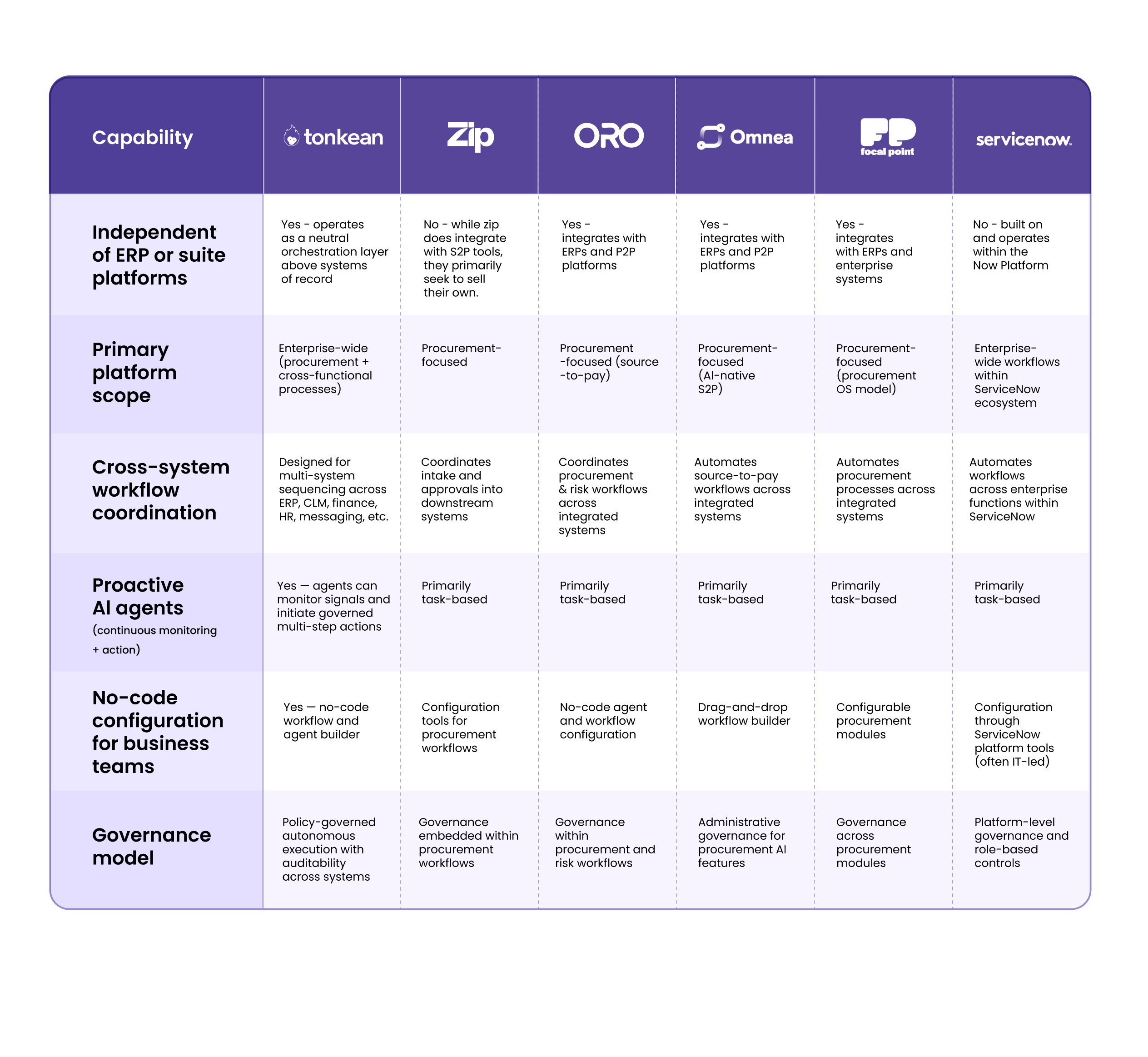
Tonkean is an end-to-end, no-code agentic process orchestration platform. Its flagship procurement orchestration solution is ProcurementWorks.
Tonkean comes with prebuilt AI agents, which work proactively to anticipate employees' needs, guide them through their requests, and conduct work autonomously under guardrails. It also comes with a no-code agent builder.
Tonkean's orchestration engine supports every stakeholder in every process by automating manual steps and managing the handoffs between people and systems in alignment with your policies. With a library of preconfigured process templates, 250+ integrations with best-in-class applications, full governance controls, and a 100% no-code workflow editor, Tonkean is the enterprise orchestration and automation platform of choice for many innovative F500 companies.
Tonkean’s mission is to power true enterprise-wide orchestration across systems, departments, and global business units.
While many procurement platforms can help organizations streamline intake, increase efficiency for work done inside one large suite, Tonkean operates in an “orchestration layer” that sits above the entire technology stack and organization, deeply integrating with innumerable enterprise systems.
And a word about those integrations.
Every vendor claims to provide hundreds of “integrations” powering proactive, autonomous “AI agents” and “end-to-end orchestration.” Do they, actually?
For enterprise G&A teams, loose self-definitions of what constitutes an actual deep, enterprise-grade integration—versus something flimsier and less reliable—are a big part of what has made the orchestration market difficult to navigate. On paper, every orchestration platform sounds the same. In practice, they are not the same at all.
The distinction between deep, enterprise-grade integrations and flimsier connectors matters because the former are what make orchestration real. They are what allow agents to conduct complex work across ERP, CLM, supplier systems, finance tools, and collaboration environments.
A connector—what most orchestration providers actually provide—is just a way for two systems to talk to each other. It can authenticate, pass a field, trigger an event, or sync a record. That is useful. It is also table stakes.
An integration is something much more consequential. It can interpret the underlying data model, permissions, business logic, and process states inside a connected system.
That matters because it’s what’s required of meaningful enterprise orchestration. It’s what allows a process orchestration platform or AI agent to monitor changes in a given system, perform actions across systems, and conduct complex cross-functional work reliably, securely, and in line with policy.
Let’s say a business stakeholder submits a request for a new software vendor in Slack. A connector can move that request into a queue.
A real integration can do much more: check whether the supplier already exists in Ariba or SAP, pull the right intake path based on category and geography, validate budget against ERP data, route a contract request into Ironclad, trigger security review, and then write approved metadata back into the purchasing system.
That’s orchestration. And it’sc the kind Tonkean provides.
Broadly, unlike point solutions that focus mostly on intake—or orchestration solutions that remain bound to one suite, or rely on connectors—Tonkean is architected for complex enterprise environments, delivering cross-functional autonomy, operational context, and scalable governance that other platforms are not designed to provide.
Also unlike other orchestration providers, Tonkean has been built to facilitate orchestration across the full scope of enterprise G&A work—legal, HR, IT finance—in addition to procurement. Which benefits procurement immensely, because procurement processes are inherently cross-functional. To orchestrate them end-to-end, you need technology that transcends the function’s siloes.
Additional details:
Tonkean is best for large, multi-entity enterprises, and especially those operating across multiple ERPs, P2P platforms, and other systems; orgs that want to preserve existing source-to-pay and finance infrastructure rather than replace it; procurement teams managing complex, cross-functional workflows involving legal, IT, finance, risk, and other stakeholders; enterprises exploring advanced AI-driven workflow automation but requiring strict governance, guardrails, and auditability across departments.
Zip is a mid-market source-to-pay (S2P) platform with select orchestration capabilities centered around procurement intake. It’s effective at simplifying purchasing for employees while giving procurement teams greater control and visibility. The platform centralizes requests, automates approval workflows, and provides native procure-to-pay capabilities – including sourcing, supplier onboarding, and PO management. Zip emphasizes a user-friendly interface that makes completing intake requests intuitive. Its model focuses on reducing friction at the point of request.
Zip is widely recognized for elevating procurement intake into a consumer-grade experience. The platform’s intuitive design and strong intake-to-procure positioning have made it synonymous with modern procurement engagement. It excels at channeling employee requests into a unified procurement workflow.
Zip is best for growth/mid-market companies who are in the early stages of maturing their procurement functions. Unlike the other vendors on this list, Zip sells a complete native source-to-pay platform. As such, Zip is best suited for organizations that are either building their procurement tech stack from the ground up or are open to ripping and replacing their existing source-to-pay platform (e.g. Coupa, SAP Ariba, etc.) – rather than those looking to preserve and enhance existing S2P investments.
Oro Labs, founded by SAP Ariba alumni, provides an intake-centric procurement orchestration platform designed to simplify how employees interact with procurement. Its core offering centers on a “procurement front door”—a single interface where business users can submit requests (for suppliers, purchases, contracts, etc.) and be automatically routed through the appropriate procurement process.
The platform leverages AI-guided intake and configurable no-code workflows. It succeeds in providing procurement teams better visibility into requests, standardizing processes, reducing email-based coordination, and improving the user experience for employees interacting with procurement
On the orchestration side, Oro provides connectors via an “embedded iPaaS platform,” which may be licensed from a third party. This allows Oro to streamline procurement requests, route work, and connect into downstream systems. But the orchestration it enables is generally limited to procurement workflows, and lacks the depth allowed by native integrations.
The platform also offers agents.
Oro stands out for its structured approach to procurement intake. The platform is purpose-built to standardize how requests enter procurement and to bring clarity and control to downstream workflows. Its strength lies in making procurement engagement consistent, trackable, and policy-aligned from the first touchpoint.
ORO’s orchestration capabilities are centered around structuring and managing procurement processes rather than operating as a flexible, system-agnostic orchestration layer across the entire enterprise stack.
Oro’s platform is more narrowly focused on procurement intake and workflow coordination rather than broader enterprise process orchestration. While Oro provides orchestration within procurement workflows and integrates with procurement systems, it typically operates as a procurement-specific layer rather than a generalized orchestration platform capable of coordinating complex, cross-functional processes across the entire enterprise stack.
Oro Labs is best for enterprise-stage companies who are heavily invested in the SAP ecosystem and have little need for other complex integrations.
Omnea is a procurement platform that combines intake and orchestration with native supplier relationship management capabilities. Its core capability is a conversational intake interface that collects procurement requests, automatically gathers required information, and routes requests through the appropriate approval, sourcing, supplier risk, and onboarding workflows.
The solution also offers product cataloging, supplier master data, approval workflows, and PO automation in a unified environment.
What stands out:Omnea emphasizes procurement automation and streamlined supplier workflows. It brings clarity and structure to sourcing, approvals, and vendor coordination, helping procurement teams operate more efficiently.
Omnea provides a single source of truth for supplier and procurement data, eliminating manual entry and fragmented systems. Its drag-and-drop workflow builder allows teams to tailor processes without heavy IT involvement, while unified dashboards surface spend, risk, and operational data for executive insights.
Omnea is best for procurement teams that want an all-in-one procurement platform with strong intake, supplier management, and procurement workflow automation. Its orchestration model remains limited to procurement, rather than acting as a broader enterprise orchestration layer. As a result, it typically lacks the ability to orchestrate complex cross-department processes. Its agents aren’t proactive. The platform as a whole is best for smaller procurement organizations for whom manual cross-system collaboration isn’t so onerous.
ServiceNow offers procurement capabilities through its Sourcing and Procurement Operations suite on the ServiceNow AI Platform. The platform provides a unified portal where employees can submit procurement requests, browse catalogs, initiate sourcing events, and track purchase requisitions and approvals. It connects people, processes, and systems through workflow automation so procurement teams can manage sourcing, vendor engagement, and purchasing tasks in a centralized environment.
The platform also includes features such as guided buying, procurement case management, analytics dashboards, and AI-assisted request handling, helping procurement teams standardize processes, automate repetitive work, and gain visibility into spend and operational performance.
Built on a single enterprise workflow engine, ServiceNow enables employees to submit requests through a unified portal while providing procurement teams with automation tools and analytics to improve cycle times and compliance.
Its platform extends beyond procurement to orchestrate workflows across IT, HR, finance, and supply chain functions. In fact, ServiceNow has deep roots in IT service management.
ServiceNow is inherently suite-focused. Procurement orchestration typically operates within the broader ServiceNow ecosystem rather than as an independent orchestration layer spanning multiple best-of-breed procurement systems. ServiceNow is often adopted by large enterprises with existing Now Platform implementations to extend procurement across their digital operations.
ServiceNow’s procurement capabilities are typically delivered as part of its broader workflow automation and service management platform, rather than a solution purpose-built for orchestrating complex procurement processes across enterprise systems. As a result, organizations often need significant configuration and custom development to adapt ServiceNow to procurement use cases.
Focal Point provides a procurement intake and orchestration platform centered on capturing requests and routing them through procurement processes efficiently. Its platform offers AI-powered intake management, centralized request tracking, conditional workflow routing, and automated task assignment based on criteria such as vendor history, workload, or process requirements.
Requests submitted through the intake layer can automatically trigger downstream procurement activities—such as sourcing events, contract workflows, or purchase orders—while maintaining visibility into request status and collaboration across stakeholders.
For procurement teams, this helps consolidate incoming requests into a single system, reduce manual coordination, and ensure that requests are routed through standardized procurement processes.
Focal Point focuses primarily on intake and procurement process coordination, with automation largely confined to procurement workflows themselves. It typically does not function as a broader enterprise orchestration platform capable of coordinating complex processes across multiple departments and business systems simultaneously.
What do enterprise procurement teams need out of orchestration?
Among other things, they need orchestration tools that don’t focus solely on intake, or that are bound within one suite. They need tools that can help them more expeditiously and reliably conduct work cross-system—that can create cohesion across resource planning systems, supplier and customer data systems, contracts, communication environments, and internal tools.
As it pertains to AI agents and agentic orchestration, meanwhile, they need agents that can conduct complex work across systems and teams.
In a recent Harvard Business Review report, “Agentic AI: Expectations, Readiness, Results,” 90% of the 623 executives surveyed said they believe agentic AI will be widely adopted in their industries—but only 26% report having seen meaningful ROI from investments in agents to-date.
Much of this stems from the cross-system limitations of the agents, and the relative lack of deep integrations behind them.
As enterprise procurement teams evaluate orchestration platforms and AI agents, the focus should shift from what can automate a task to what can coordinate complex work across the enterprise.
Enterprise-grade agentic orchestration starts with making available to agents unified, real-time context into how work happens across teams and tools: ERP systems, contract repositories, supplier data, finance platforms, and collaboration tools. It hinges as well on seamless integrations across those tools. Without that connective tissue, automation remains fragmented.
Here’s the truth: Procurement work is never confined to one system:
Agents should continuously monitor signals, identify risks or opportunities, and initiate action, not simply respond to requests. Just as importantly, this autonomy must be governed, with policy controls, auditability, and clear human oversight embedded in the agents’ design.
For enterprise procurement leaders, these are the standards that define real agentic orchestration. Platforms must move beyond task acceleration and insight generation to deliver secure, coordinated execution across global operations. That is the bar enterprise teams should expect as AI agents become foundational to procurement strategy.
Procurement orchestration in 2026 is at a turning point. What once meant stitching together intake forms and workflow automation now points toward something far more powerful: end-to-end orchestration augmented by tightly governed, cross-system, autonomous AI agents that can proactively execute work across ERP, CLM, finance, legal, and beyond.
It’s an exciting time to be in this space because the technology has finally caught up to procurement’s ambition—enabling teams to move from reactive processing to strategic, autonomous execution.
But realizing that potential requires understanding the technology underneath the label. Not every “orchestration” platform is built for enterprise-wide context—some remain intake-first, others power only suite-bound workflow platforms—and not every AI feature represents true autonomy. You might not need enterprise-grade orchestration. But to fully capture the opportunity ahead, procurement leaders need to know exactly what each type of orchestration looks like, and in turn might work best for them.
Want to learn more? Get in touch.