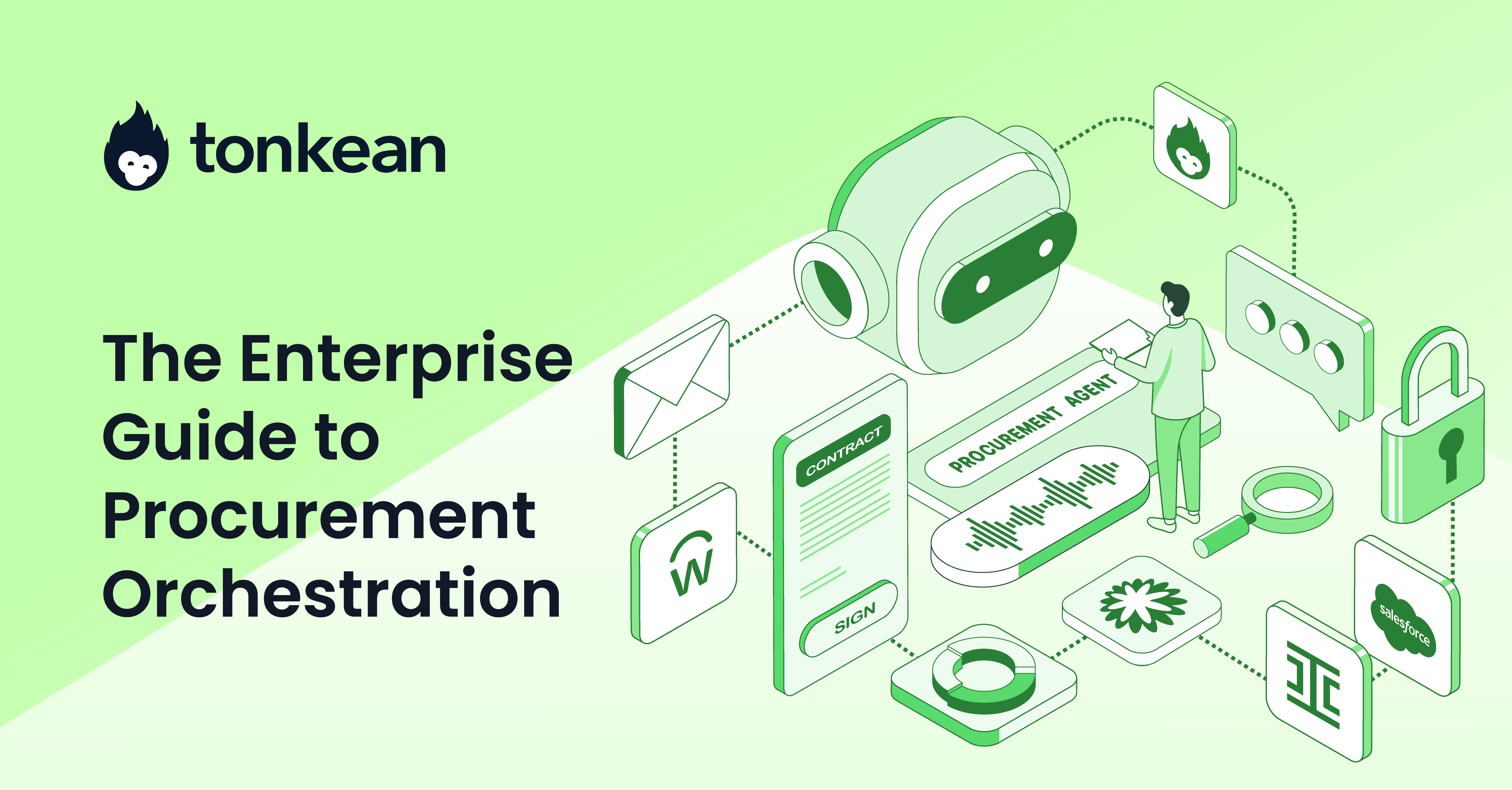
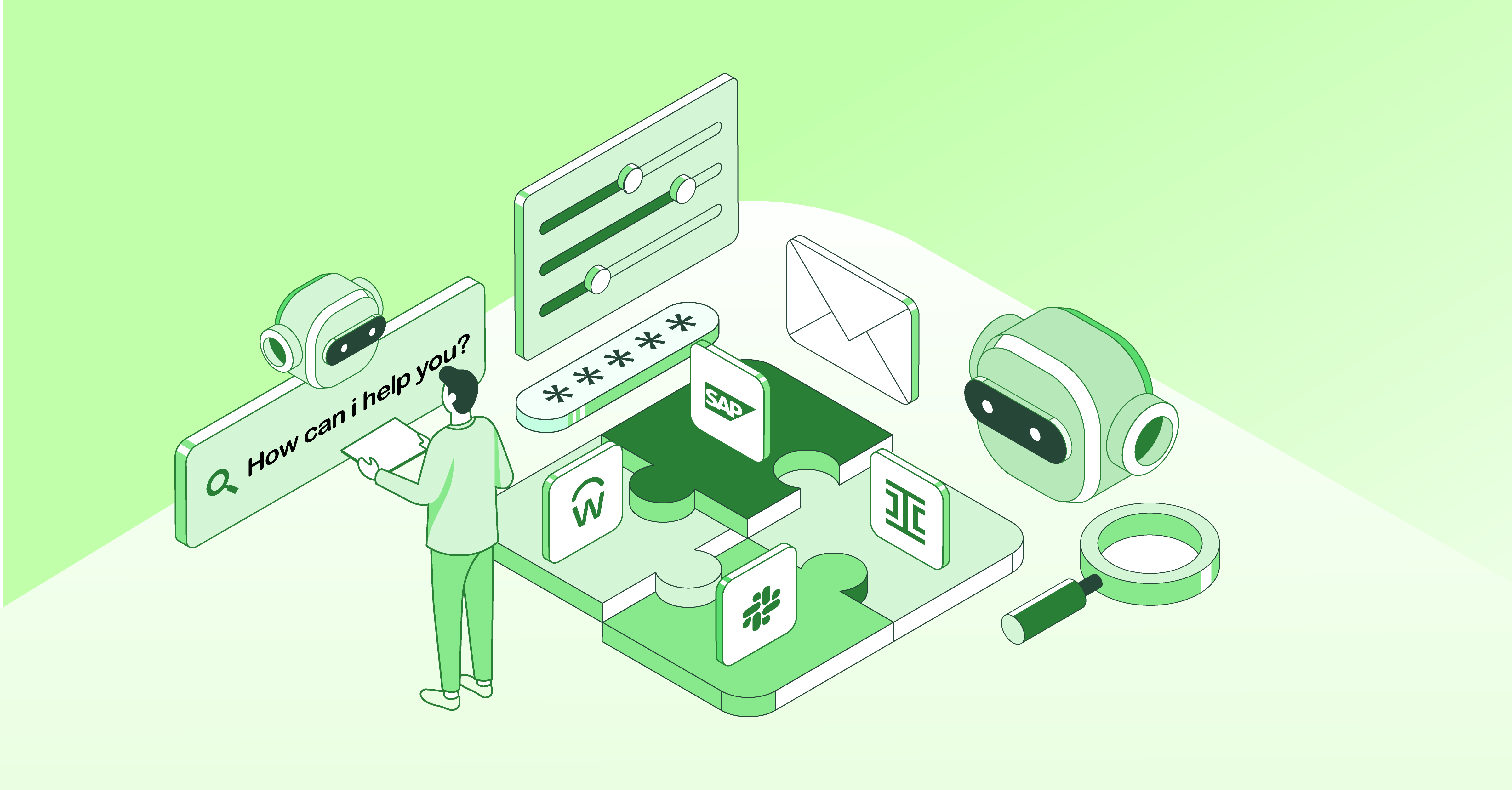
There’s a moment of clarity that follows every procurement leader’s first real experience with enterprise-grade procurement orchestration. With procurement agents that move work seamlessly across systems. With intake experiences that accommodate employees’ individual working styles. With enterprise-grade integrations that provide, finally, a connective tissue spanning the whole organization.
They recognize where their efficiency has been going to die.
The issue, they realize, has not been the tools themselves—which is why further crowding your tech stack doesn’t work, as an operating strategy. Rather, it has been in the space between tools, and in their inability to reliably bridge it.
Enterprise procurement orchestration technology functions as the control layer of enterprise work. Enterprise procurement teams use it to coordinate work across people, systems, databases, policies, and AI agents—enabling procurement teams to accelerate execution, improve compliance, reduce risk, automate menial work, and create explosive new business value without replacing existing investments.
Think of orchestration technology as a catwalk suspended above your tech stack, policy docs, and org chart, from which ops teams can orchestrate their organization’s moving parts. Orchestration platforms are not meant to replace any of these moving parts—not your S2P suites or ERP systems or for that matter any other tool your company uses. They’re intended, instead, to help you use all your tools better together, in a manner responsive to the complex realities of enterprise work.
We’ve written this guide as a primer to help you get started leveraging process orchestration technology to do precisely that.
Now, you may be thinking to yourself: well, wait, I don’t need that! I know all about process orchestration technology. After all, it’s been among the buzziest procurement technology categories for years, now—and even more so lately, as it’s emerged as the essential infrastructure for AI agents.
The truth, however, is orchestration as a category remains misunderstood. Too many still perceive it as a bolt-on solution, something that looks like traditional SaaS. In fact, its promise is to finally transcend SaaS’s traditional limitations. But only if you use it correctly.
The stakes, we’ll add, are high. Orchestration technology has been maturing for several years, but 2026 has emerged as something of a watershed moment. In no way is this reflected more clearly than in Tonkean’s recent acquisition by Coupa.
As Tonkean co-founder and CEO, Sagi Eliyahu, wrote, “Companies across the world are rapidly shifting from a traditional SaaS-based operational model, where it is incumbent upon humans to compensate for the limitations of siloed technology systems, to an agentic one, where humans operate as orchestrators, coordinating autonomous agents across policies and connected systems end-to-end.”
For the first time, he goes on, companies will own “a fully connected digital workforce of autonomous AI agents—as well as a seamless way to coordinate complex work across policies, systems, agents, and people.”
It’s a step-change, one with the very real potential to change how procurement teams operate. We wrote this guide to help you get out ahead. Let’s get started.
The story of enterprise procurement technology is, in many ways, the story of business software itself. ERPs in the nineties promised a single source of truth. Browser-based requisition portals in the early 2000s promised frictionless self-service. Cloud-first P2P suites in the 2010s promised analytics, supplier risk management, and category-specific sourcing in one place. Through each successive wave, procurement teams grew more capable and delivered more value—but each new point solution also introduced new seams that had to be integrated, reconciled, and governed. The gains were real. So were the new problems.
This is where orchestration comes in—to answer this pressing question: how do we actually get these systems to work together well enough to deliver on the transformative value we were promised when we bought them?
Procurement leaders are investing in orchestration not simply to connect systems, but to accelerate execution across sourcing, procurement, supplier management, contracts, and finance. The goal isn’t connectivity for its own sake. It’s faster cycle times, stronger compliance, better stakeholder experiences, greater visibility, and a scalable foundation for AI-powered work. The orchestration layer serves as the nexus of operational control, helping you coordinate work across systems, policies, people, suppliers, and AI agents.
Unsurprisingly, investment in orchestration has grown sharply over the last few years, and the teams that have adopted orchestration most comprehensively are reporting meaningfully better outcomes—higher compliance rates, faster cycle times, more consistent stakeholder experiences, and greater visibility into spend in flight.
But it’s only a particular kind of orchestration investment that provides such returns. It’s that which is coordinated through an orchestration layer, which itself powers one of the most underappreciated requirements for effective orchestration: deep, reliable integrations. Not connectors.
Enterprise AI agents require more than access to systems. They require governed access to business context, approval logic, supplier data, contracts, and policies. This is why enterprise-grade orchestration depends on deep integrations capable of supporting real-world execution, not just data exchange.
This finding aligns with something Tonkean has observed consistently across our enterprise customer base, as well. Procurement teams that have invested in orchestration as a control and execution layer are building a new architecture for agentic-powered procurement work.
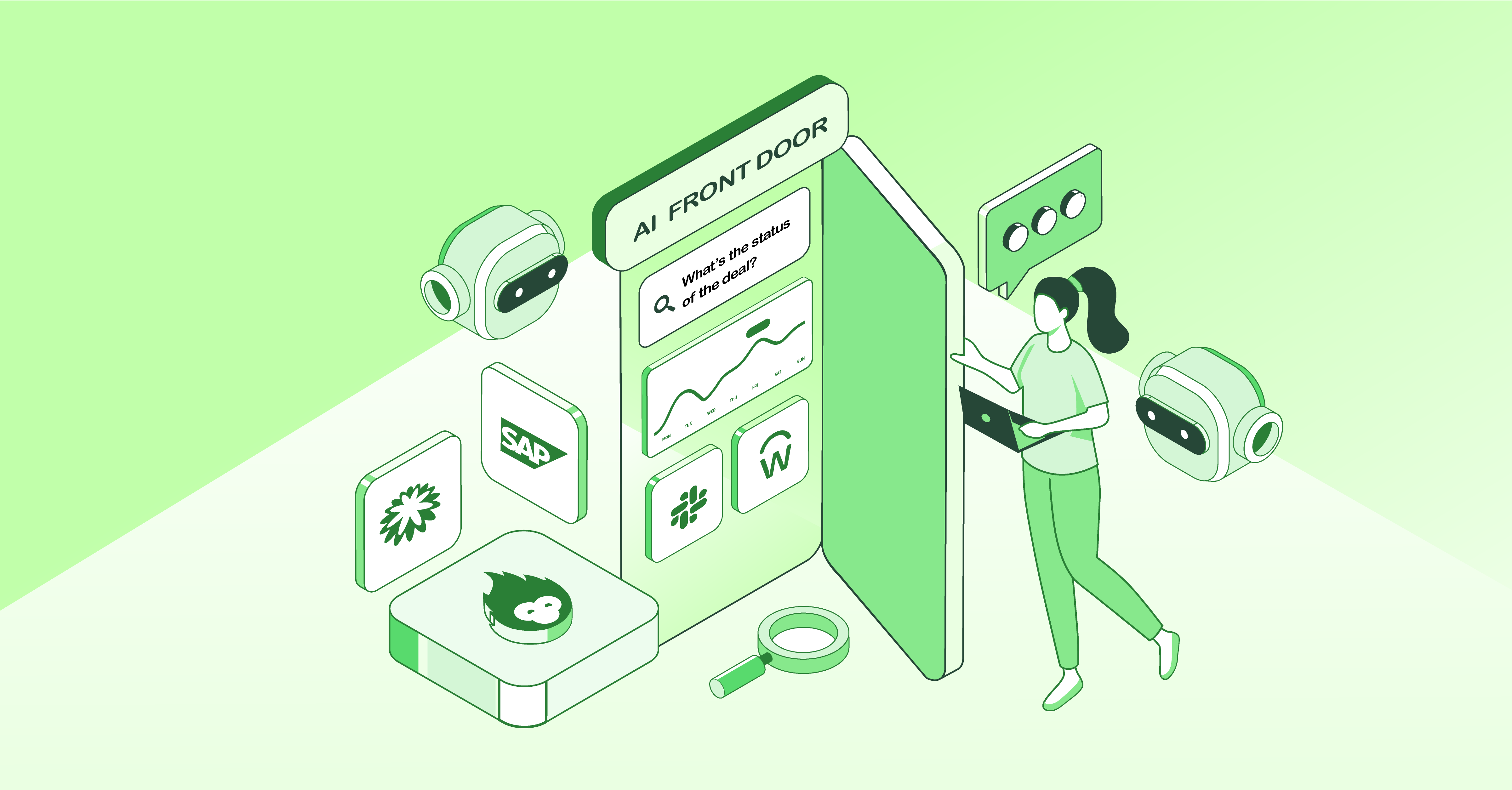
But let’s back up. Let’s say you’ve got orchestration plugged in. Before a procurement team can fix its cycle times, improve its compliance rates, or deploy AI agents to do complex autonomous work, it has to fix its front door.
Intake is where the procurement experience begins for every stakeholder in an organization—the engineer who needs a new SaaS tool, the marketing manager who needs a vendor contract reviewed, the finance team member who needs to onboard a new supplier quickly. It is also, historically, where the procurement experience most reliably breaks down. Stakeholders don't know which system to use, or which form to fill out, or which team to contact. They submit requests that arrive missing critical information. They email the wrong person and wait. They submit the same request through three different channels because they received no confirmation that the first one was received. They route around procurement entirely—the dreaded "maverick spend" problem—because the process of engaging procurement feels more painful than whatever workaround they can improvise on their own.
This is not a hypothetical. According to Tonkean's survey data and consistent feedback from enterprise procurement leaders, friction at intake is one of the primary drivers of low adoption of P2P tools, high rates of non-compliant spend, and poor satisfaction scores among internal stakeholders. The intake problem is the first domino. Get it wrong, and every downstream process suffers—because the data quality, the context, and the routing decisions that everything downstream depends on are poisoned at the source.
Intake orchestration is the practice of leveraging an intelligent orchestration layer specifically to facilitate this front-door moment—usually through what’s become known as an AI Front Door.
The AI Front Door is more than an intake experience. It serves as the intelligent entry point for employees into your company’s processes. Requests are interpreted, enriched with context, and routed to the appropriate agent-powered workflow. From there, the work entailed by the request is completed through a collaboration between humans and agents, coordinated through the execution layer.
This is meaningfully different from a static intake form.
A form can't understand that a request for "a vendor who does marketing analytics" is probably a sourcing request that will require supplier evaluation and an NDA.
A form can't detect that a request is for a renewal of an existing contract and proactively surface the current contract's key terms, auto-populated from the CLM.
A form can't recognize that a stakeholder has submitted an incomplete request and ask follow-up questions in a way that feels helpful rather than bureaucratic.
An AI-powered intake layer can do all of these things—and in doing so, it dramatically improves the quality of data entering the procurement process, the speed at which requests are triaged and routed, and the experience of every stakeholder who interacts with procurement.
Why is fixing intake the critical first step for every procurement team hoping to derive transformative value from orchestration? Because every downstream benefit of orchestration depends on what happens at intake. The AI agents you want to deploy to conduct autonomous sourcing analysis need requests that are clean, complete, and properly classified to work with. The compliance workflows you want to automate need requests that have already been routed correctly. The spend visibility dashboards your CPO relies on need data that was captured accurately the first time, not reconstructed after the fact from incomplete records.
Getting intake right is foundational in another sense too: it's often the fastest path to demonstrable, visible ROI from an orchestration investment. Stakeholders notice immediately when procurement becomes easier to engage. Procurement teams notice immediately when the volume of incomplete requests drops and the time to initial triage shrinks. Leadership notices when maverick spend declines and PO compliance climbs. Intake orchestration, done well, is the kind of change that creates its own momentum—because it earns trust and adoption from every direction at once.
For procurement teams just beginning their orchestration journey, the message is clear: start here. Deploy an intelligent intake layer. Fix the front door. The ROI is fast, the adoption is visible, and the data quality improvements you achieve will make every subsequent orchestration initiative more effective.

The confusion between orchestration platforms and source-to-pay suites is one of the most persistent—and most consequential—in enterprise procurement technology today. It's worth addressing directly, because getting it wrong is expensive.
Source-to-pay suites are systems of record. They are designed to capture, store, and process procurement transactions: purchase requisitions, purchase orders, supplier invoices, contract repositories, sourcing events. They provide the authoritative data about what was bought, from whom, at what price, under what contract terms. They are, in the language of enterprise architecture, the transactional backbone of procurement operations. No serious enterprise procurement function operates without one, and for good reason: the data integrity, compliance infrastructure, and audit capability they provide are foundational.
But S2P suites were designed to manage structured, predictable procurement processes—the kind where a stakeholder knows exactly what they need, submits a properly formatted requisition, and the request flows cleanly through a predefined approval chain to a purchase order. They’re capable of orchestrating work, but only that which exists inside the suite.
The reality of enterprise procurement, of course, is that the overwhelming majority of requests don't arrive this way, much as most procurement work, being inherently cross-functional, has to happen outside the suite.
Requests arrive as a question in Slack. They arrive as an email to procurement's shared inbox. They arrive as a conversation between a business unit leader and their finance partner. They arrive with missing information, ambiguous categorization, and unclear urgency.
Approvals, collaboration, achieving outcomes, whether via manual human intervention or AI agents—all this, meanwhile, often demands going outside the suite, as well
This is where orchestration comes in. Orchestration platforms don't replace S2P suites. They work alongside them, operating at the control layer above this transaction layer.
The orchestration layer becomes responsible for everything that happens before, between, and around the transactional steps recorded in the S2P system: capturing the initial request (wherever it originates), gathering and validating the context needed to process it, routing it intelligently to the right people and systems, enforcing policy and approval logic dynamically, coordinating the handoffs between procurement and legal and finance, and ensuring that the S2P system receives clean, complete, properly categorized data.
In practice, this means procurement teams can automate work that traditionally falls between systems: supplier onboarding, sourcing coordination, contract routing, risk reviews, stakeholder communications, and agent-driven execution.
Think of it this way: the S2P suite is the destination. Orchestration is the infrastructure that ensures every request arrives at that destination in the right form, through the right path, with the right information attached. It’s the means by which agents are empowered to complete work inside and out of the suite.
Without orchestration, the journey from "I need something" to "purchase order issued" is full of friction. With an orchestration layer, that journey can become seamless and can even be made autonomous.
There is another crucial difference that often goes under-discussed: configurability and adaptability. S2P suites are, by design, relatively rigid. Their workflows are configured during implementation, and changing them typically requires significant IT involvement and project timelines measured in months.
This rigidity is partly intentional—it protects data integrity and ensures compliance—but it also means that S2P suites struggle to keep pace with the rate at which procurement processes and procurement agents actually need to evolve. Category strategies change. Business units acquire new subsidiaries with different processes. Risk thresholds shift. A new regulatory requirement changes the information that must be captured for certain supplier types.
An orchestration layer, by contrast, is designed to be adaptive. It sits above the S2P system. Procurement teams can iterate on workflows quickly, deploy new intake experiences for specific categories or business units, deploy teams of agents with agility, and update routing logic and approval matrices without touching the underlying S2P configuration.
This is why the Coupa-Tonkean combination is so significant. Coupa is the industry's gold standard for the transactional layer. Tonkean is the enterprise standard for the orchestration layer. Together, they represent a full-stack vision of procurement operations in which no tension exists between the rigidity of the system of record and the adaptability of the process layer—because both are provided by a single, integrated platform. Enterprise procurement teams should be paying close attention to this: the convergence of these two layers into a unified platform is not a distant possibility. It is happening now.
Ask any CPO what keeps them up at night, and contracts will be somewhere near the top of the list. Not because contracts are hard to sign—organizations sign contracts every day. Because what happens after signing is so poorly managed that the obligations those contracts contain routinely go untracked, unmonitored, and unenforced.
The problem is structural. The moment a contract is executed and filed in the CLM—or, in many enterprises, in a shared drive or email folder—the meaningful management of that contract's obligations often ends. Renewal dates are tracked in spreadsheets. Supplier performance commitments are reviewed only when something goes wrong. Liability caps and indemnification clauses are referenced only when disputes arise. Pricing schedules are assumed to be correct because manually verifying them against every invoice would require headcount that doesn't exist. The post-signature life of a contract—what Tonkean calls the obligation lifecycle—is, in most enterprises, almost entirely unorchestrated.
This is why Tonkean built Contracts Hub, and why the concept of obligation orchestration deserves a prominent place in any serious discussion of procurement orchestration.
Obligation orchestration is the practice of applying an intelligent orchestration layer specifically to the lifecycle of contract obligations—ensuring that every commitment made in a contract is tracked, monitored, and actioned appropriately, from the day of execution through renewal or termination. It sits alongside contract lifecycle management tools like Ironclad, Icertis, or Agiloft, which handle the transactional mechanics of contract creation, review, and storage. Obligation orchestration goes further: it actively manages what those contracts require, both from your organization and from your suppliers.
Tonkean Contracts Hub was designed to operationalize this concept. Built natively on Tonkean's agentic orchestration platform, Contracts Hub uses AI agents to extract obligations from executed contracts, structure them for tracking and monitoring, surface upcoming deadlines and commitments before they become issues, and route exceptions and escalations to the right stakeholders automatically. The result is a contract management experience that doesn't end at signature—it begins there.
Consider what this means in practice. A supplier contract committing to 99.5% uptime with financial remedies for breach is common. Monitoring that commitment against actual performance data, flagging deviations, and initiating the remedy process when SLAs are missed—without any human having to manually check the contract and cross-reference the performance report—is rare. Obligation orchestration makes it possible.
Or consider the more common problem of renewals. Most enterprise procurement teams can tell you how many contracts are renewing in the next 30 days. Very few can tell you which of those renewals represent strategic leverage opportunities, which suppliers have underperformed against their commitments, and which contracts contain auto-renewal provisions that will lock the organization into unfavorable terms if no action is taken. An obligation orchestration layer surfaces all of this proactively, giving procurement the time and context to act strategically rather than reactively.
There is also a risk management dimension that is increasingly difficult to ignore. As regulatory requirements multiply—around supplier ESG compliance, data protection, financial controls—the obligation to monitor and document contract compliance has grown correspondingly. Manual approaches to this monitoring are simply not scalable. An AI-native obligation orchestration layer that continuously monitors contract terms against real-world data, generates compliance documentation automatically, and alerts procurement when risk thresholds are approached isn't a luxury. It's fast becoming an operational necessity.
Obligation orchestration fits into the broader procurement orchestration picture as the post-signature complement to intake orchestration. Just as intake orchestration ensures that every request enters the procurement process with the right context and routing, obligation orchestration ensures that every contract that exits the signing process is actively managed through its full lifecycle. Together, they close the loop—from the moment a need is identified to the moment the last obligation under the resulting contract has been fulfilled.
The AI hype cycle has been particularly intense in procurement. Over the past several years, virtually every procurement technology vendor has announced "AI capabilities"—AI-powered spend classification, AI-assisted contract review, AI-driven supplier risk scores, AI chatbots for procurement Q&A. Many of these capabilities are genuinely useful. But the gap between what's been promised and what most enterprise procurement teams are actually achieving with AI remains large. Understanding why that gap exists—and how agentic orchestration closes it—is perhaps the most important thing a procurement leader can learn in 2026.
Most enterprise procurement teams are using AI today in a reactive, single-task mode. They're using an AI tool to help classify spend categories. They're using an AI assistant to summarize contract language. They're using a chatbot to answer procurement policy questions from employees. Each of these applications delivers value. But none of them represents the transformative potential that procurement leaders were originally excited about—the promise of AI that can conduct complex, multi-step work autonomously, across systems, without constant human intervention.
The reason most procurement teams haven't gotten there yet is not the AI itself. It’s the infrastructure. Specifically, the absence of an orchestration layer capable of giving AI agents the context they need to do real work in a real enterprise environment.
For example: an AI agent tasked with evaluating a new supplier—checking against an approved vendor list, running a risk score, reviewing relevant contract terms, checking compliance with procurement policy, routing to the appropriate approver, and updating the sourcing record—needs more than access to a search engine, a data source, or a language model. It needs structured access to the organization's vendor master in Coupa. It needs the ability to read and interpret contract terms from the CLM. It needs to understand the organization's category-specific approval matrix. It needs to know which business unit the request is coming from and what their spend authority thresholds are. It needs policy context. It needs organizational context. It needs process context.
In short: AI agents need the same things a skilled procurement employee needs to do their job. They need context, in addition to connection.
Procurement leaders should think less about deploying individual AI agents and more about building an AI workforce. The orchestration layer provides the governance, context, and coordination required for specialized agents to work together across sourcing, procurement, contracts, supplier management, and finance.
Just as modern procurement organizations rely on specialized teams, the future of AI-powered procurement will rely on specialized agents working together across the procurement lifecycle. Sourcing agents, supplier onboarding agents, contract agents, risk agents, and invoice agents each perform domain-specific work while the orchestration layer coordinates activities, enforces policies, maintains auditability, and keeps humans in control of critical decisions.
This is where agentic orchestration becomes the decisive differentiator. Agentic orchestration isn't just a layer that connects systems. It's a layer that builds and maintains the contextual infrastructure AI agents need to conduct work responsibly. An agentic orchestration platform provides AI agents with deep integrations that go well beyond API connectors—integrations that surface the right data in the right structure for the agent's specific task, enforce the approval logic and policy constraints that govern what the agent is allowed to do, and maintain the audit trail that makes the agent's decisions explainable and reviewable. Without this infrastructure, AI agents in procurement are either too limited to do meaningful work, or too unconstrained to be trusted with meaningful work. Neither outcome is acceptable.
A critical and underappreciated point: the difference between a connector and a deep integration is not cosmetic. Many agentic orchestration vendors advertise hundreds of integrations. Most of what they're counting are thin connectors—API bridges that can authenticate a session and read a field, but that don't understand your data model, can't operate inside your approval logic, and weren't designed to support the level of structured, governed, enterprise-grade interaction that autonomous AI agents require. This distinction is about to become very expensive for organizations that bought the pitch without reading the fine print.
Genuine agentic orchestration—the kind that can power AI agents doing real procurement work—requires integrations that handle your actual data model, operate inside your approval logic, enforce policy across systems, and handle exceptions without failing. It requires an orchestration layer that has accumulated the organizational context—the org charts, the category strategies, the supplier relationships, the historical spend patterns—that AI agents need to make decisions that are not just technically correct but operationally appropriate.
The future of well-instrumented AI agents in procurement is genuinely exciting. It looks like a sourcing agent that, when triggered by a new intake request, independently evaluates three potential suppliers from the approved list, runs risk scores against your preferred provider, checks for existing contracts that might already cover the need, drafts an NDA for any new supplier under consideration, and presents procurement with a recommendation—all before a human has touched the request. It looks like a contract renewal agent that reviews performance data against SLA commitments for every contract renewing in the next 90 days, identifies which suppliers have underperformed, calculates what leverage points exist in each renewal negotiation, and surfaces its findings in a weekly briefing to the category manager. It looks like an invoice processing agent that receives an invoice, validates it against the PO and contract terms, identifies any discrepancies, routes exceptions to the right reviewer, and updates the ERP record—without any human involvement for the 80% of invoices that are clean.
This is what you can get when you combine capable AI agents with genuine agentic orchestration infrastructure. The organizations that invest in building that infrastructure now will be the ones realizing these gains in the near term. It is, in short, the next step for orchestration.
Knowing that orchestration can transform procurement is one thing. Knowing where to start—specifically, which workflows to orchestrate first, and in what order—is another. For most enterprise procurement teams, the answer is to begin with the workflows that are highest in volume, most cross-functional in their dependencies, and most likely to produce visible, measurable improvements quickly. Here are six core use cases that meet all three criteria.
This is, as discussed above, the natural starting point for most procurement orchestration programs—and for good reason. Every procurement process begins with a request, and every downstream inefficiency can be traced back to how well or poorly that request was captured, classified, and routed. Orchestrating intake means deploying an AI-powered front door that meets requesters in Slack, Teams, or email; understands their request in natural language; gathers the context needed to classify and route it correctly; and hands it off to the right downstream workflow—whether that's a guided buying experience in Coupa, a sourcing event in Ariba, or a contract request in the CLM. The returns here are fast and visible: higher compliance rates, faster triage, fewer incomplete submissions, and measurable reductions in maverick spend.
Supplier onboarding is one of the most cross-functional, time-intensive processes in procurement—and one of the most frequently broken. It requires coordination between procurement, legal, finance, IT, and often compliance or information security. Information is gathered through a combination of emails, spreadsheets, and portal submissions, then manually reconciled and routed through approval chains that vary depending on the supplier type, spend category, and geographic region. An orchestration layer automates the intake of onboarding requests, routes the relevant questionnaires to the right parties (and follows up automatically when responses are overdue), coordinates the review stages across functions, and updates the vendor master in the ERP or P2P system when onboarding is complete. Cycle time reductions of 50–70% are achievable, and the data quality improvements downstream are substantial.
For most enterprise procurement teams, contract requests and NDAs represent a high volume, low-complexity category that nevertheless consumes a disproportionate share of procurement and legal bandwidth because the process for handling them is inconsistent and manual. Orchestrating contract requests means creating a structured intake experience that captures the relevant details (parties, deal type, sensitivity, urgency), classifies the request appropriately, routes standard NDAs to an AI agent for autonomous drafting and review (with human escalation only for non-standard terms), and tracks the contract through signature and into the CLM. Teams that orchestrate this workflow typically see dramatic reductions in NDA cycle times—from days or weeks to hours—while actually improving consistency and compliance.
Invoice processing is a workflow that most enterprises believe they've automated—and most haven't, at least not completely. The 80% of clean invoices that match their POs and contract terms may flow through automatically. The remaining 20%—the exceptions—pile up in a shared inbox, waiting for a human to investigate, escalate, and resolve. Orchestrating invoice processing means applying an AI layer that validates each invoice against the relevant PO and contract terms, identifies discrepancies automatically, routes exceptions to the right reviewer with full context already assembled, and updates the ERP record when resolution is complete. The productivity gains are significant, and the cash flow visibility improvements that come from faster, more consistent processing have balance-sheet-level implications for large enterprises.
When a business unit brings a sourcing need to procurement, the steps that follow—supplier identification, RFx development, bid evaluation, selection, and award—are heavily manual and deeply dependent on the knowledge and bandwidth of individual category managers. Orchestration doesn't replace category management judgment. It amplifies it. By automating the intake and classification of sourcing requests, surfacing relevant historical data and existing contracts before the category manager has to look for them, coordinating the logistics of the RFx process (including supplier invitation, deadline management, and bid consolidation), and routing the final award decision through the appropriate approval chain, orchestration allows category managers to focus their expertise on the decisions that require it—rather than on the coordination work that surrounds those decisions.
As described in the contracts section above, the post-signature lifecycle of a contract is one of the most neglected—and most consequential—areas of procurement operations. Orchestrating obligation monitoring means connecting an AI layer to the CLM that extracts and structures the key obligations from each executed contract, monitors performance data and compliance signals continuously, surfaces upcoming renewal dates with appropriate lead time, flags exceptions and SLA breaches for review, and initiates renewal workflows at the right moment with the right context already assembled. For organizations managing hundreds or thousands of supplier contracts, this capability is not an incremental improvement. It is a fundamental transformation of how contractual value is captured and protected.
Finally, for a list of all of Tonkean’s pre-built proactive procurement agents, start here.
Procurement orchestration is not an all-or-nothing proposition. The teams that see the most durable transformative success are not the ones that tried to transform everything at once. They're the ones that started with intake, earned trust and adoption quickly, and then instrumented the orchestration layer systematically, until the orchestration layer itself became the operating standard and internal engine powering how procurement work gets done—and handling, automatically, all the manual work of bridging your organization’s formerly siloed components.
The technology is ready. The market is validating. And with Coupa and Tonkean now combining to build the world's most powerful agentic orchestration capabilities for spend management, the window for getting out ahead of this shift is open—but not indefinitely.
Start with intake. Build the integration foundation. Instrument your AI agents properly. And recognize that every workflow you orchestrate well today is infrastructure for the autonomous procurement function you're building for tomorrow.
Faster procurement cycle times
Reduced manual work
Higher stakeholder adoption
Increased policy compliance
Improved supplier visibility
Greater AI utilization
Better spend governance
Ready to see what procurement orchestration looks like in practice for your organization? Schedule a demo with Tonkean.